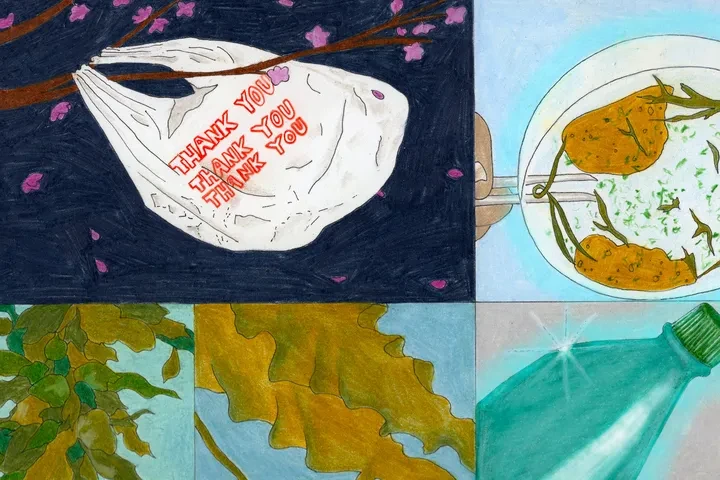
The Three-Pronged Plan to Unplastic Our World
The humble disposable plastic bag might just be the most overengineered product humanity has ever created. A few years back, I popped into a local French deli to pick up several large blocks of cheese, and carried my purchase home in a thin plastic grocery bag. The cheese was so heavy that the bag stretched tight, bulging at the seams, and its handles cut sharply into my palms. Yet it never tore.
That’s all thanks to plastic’s almost magical chemistry: at its core, plastic is solidified oil, built from carbon and hydrogen atoms arranged in repeating chains that form long, noodle-shaped molecules. These molecules are both flexible and incredibly tough — two properties that make plastic so universally useful, and astonishingly durable. After I unpacked my hunks of Camembert and Havarti, I stuffed the bag into the back of a kitchen drawer and forgot about it. When I stumbled across it again a few weeks back, it was still in perfect, like-new condition.
Of course it was. Plastic bags can remain intact and usable for decades. Which is completely absurd, isn’t it? We manufacture a bag tough enough to last generations, use it for maybe 10 minutes, then stuff it in a drawer or, more often than not, send it off to a landfill. There, it can break down into tiny microplastic fragments that persist in the environment for hundreds of years. Like I said: the most overengineered object on Earth.
The environmental crisis of single-use plastics haunts our collective consciousness like a persistent, unseen threat, and for good reason: the sheer volume of plastic goods we produce for daily use is staggering. Plastic is of course ubiquitous in grocery bags, but it also turns up in everything from yoga pants and car tires to construction materials, children’s toys, and critical medical supplies.
The global shift toward plastic happened incredibly fast: plastic use was relatively limited until the 1970s, when it exploded in popularity, tripling in volume by the 1990s. Then growth accelerated even more: over the next 20 years, we used as much plastic as we had in the entire previous 40. Today, we generate more than 500 million tons of plastic waste every year globally. Only 9 percent of all plastic ever produced has been recycled.
The rest ends up in landfills or is incinerated, releasing toxic fumes into the air — most often in low-income neighborhoods disproportionately burdened by pollution. A large portion also flows into the world’s oceans, which now hold as much as 219 million tons of plastic waste: packaging washing up on remote coastlines, chunks eaten by marine life, whole floating islands of plastic garbage collecting in open-ocean gyres.
This is far too much plastic, and most of us agree we need to reverse course on the global plastic revolution. If we’re going to start making meaningful progress, cutting back on single-use plastics is the logical first step: according to the UN Environment Programme, single-use products account for a full 36 percent of all plastic we use every year.
Walking away from single-use plastics is no simple task, partly because we rely on so many different types of plastic for so many different uses. We have thin films like shopping bags, thicker molded plastics for takeout containers, multi-layered plastic packaging for grocery store meat, and clear PET plastic for soda and water bottles. Each has its own unique chemical properties, molecular structure, and performance requirements. There is no single one-size-fits-all replacement that works for every type of plastic packaging we use today.
That said, there are a growing number of promising developments in how we approach the single-use plastic problem, following a three-pronged strategy that experts have converged on over the past several years. The plan breaks down to three core fronts:
Replace some single-use plastics with truly home-compostable alternative materials
Swap another large share for long-lasting reusable containers made of metal or glass
Rework economic and policy incentives to make plastic recycling actually functional and profitable
This isn’t my own personal battle plan — it’s a framework I heard over and over again throughout the past year, as I interviewed dozens of scientists, inventors, entrepreneurs, and policy experts working on this issue. None of these approaches are a guaranteed home run. They will require not just technological innovation, but also targeted government incentives and strong regulation — efforts that are already being fiercely resisted by large petroleum companies that profit from plastic production. But when you add up all the ongoing work to move beyond plastic, there is good reason for cautious optimism: we already have a clear path forward to a world far less cluttered with indestructible plastic waste.
Standing in her sunlit lab in San Leandro, California, Julia Marsh handed me a small clear pouch, shiny like cellophane, the kind brands commonly use to package a pair of earrings or a handful of candy. “These things are absolutely everywhere,” Marsh told me.
As I turned the pouch over in my hands, I noticed it was a little stiffer than a typical plastic polybag. That’s because it’s made entirely from seaweed, built from the plant’s natural polysaccharides: long chains of carbohydrate molecules.
It doesn’t perform exactly like an oil-based plastic bag, but it offers a far better tradeoff for the planet: Marsh says you can toss this seaweed bag in your home compost pile, and after a few weeks only tiny fragments will remain. After six months, it will have fully broken down into organic matter that becomes part of your soil.
Bioplastics aren’t a new idea — for decades, engineers have developed plastic alternatives from crops like sugarcane and corn. But the biggest hurdle has been ensuring these materials actually break down naturally in the environment. Most existing bioplastics can only decompose in high-heat industrial composting facilities, which are extremely rare across most of the United States. And many commercial bioplastics contain chemical additives that never break down at all.
Marsh wants to fix that. A 30-year-old with a laid-back, surfer-like energy, she grew up playing in the water along Central California’s coast. She marveled at the region’s abundant natural beauty and marine life — and grew increasingly horrified by the flood of plastic ocean pollution, including dead whales found with stomachs full of plastic waste. She moved to New York to pursue a career in design focused on branding and packaging, but after seeing first-hand how wasteful companies were when it came to shipping and wrapping products, she walked away. She didn’t want to build a career creating endless amounts of trash.
Instead, Marsh decided to tackle the plastic packaging problem head-on. The global fashion industry uses billions of thin plastic “polybags” every year to ship clothing. What if she could make those polybags out of a material that could actually compost completely?
She didn’t want to work with food crop feedstocks like corn, though. To produce mass quantities of bioplastics from corn, you’d need to clear huge amounts of land, degrade soil health, and emit massive amounts of carbon dioxide. Marsh’s partner, Matt Mayes, was studying for a master’s in sustainable development, which brought him to Indonesia. She joined him for a visit and toured local seaweed farms, which gave her an idea: maybe seaweed was a better building block for bioplastics.
Seaweed has natural gelling properties that work perfectly for making thin films — in fact, it’s already used to give toothpaste and cosmetics their smooth, thick texture. Even better, Marsh noted, seaweed “regenerates really quickly,” so you get fast harvests while using far less space than corn. She ticked off its other benefits: “It requires virtually zero inputs to grow. Really low carbon usage, really low energy. No fertilizer, no arable land — no fresh water! And seaweed farms act as natural water filtration systems, and provide habitat for biodiversity.” A handful of European startups were already experimenting with seaweed for everything from takeout container liners to rehydration gels for athletes, so the idea had already caught on in small circles.
Back in New York, she started running experiments in her kitchen. After browsing tutorials on YouTube, she learned she could order powdered seaweed polysaccharides online, mix them with hot water to make a thick gel, and let it cool into a plastic-like material. Pulling out her phone, she showed me photos of her early results: lumpy, misshapen green dishes and bowls. “Really horrible, ugly, disturbing-looking prototypes,” she laughed. But she learned that bioplastics weren’t “necessarily about super complicated science” — they just required years of trial and error. If she hired experienced materials engineers, she figured, they could make real progress on the polybag problem.
She and Mayes founded their startup, Sway, in the early months of the Covid pandemic; their first hire was Matt Catarino, a materials engineer who’d worked six years in what he calls “Big Plastic,” engineering everything from medical waste bags to protective car film. But he’d grown tired of the work and wanted a change. Over the next few months, Catarino produced a working crude thin-film prototype that earned the startup $2.5 million in seed investment. Sway poured that money into hiring more staff and renting a lab space in San Leandro.
When I visited last year, Marsh pulled me over to a rack holding four thick rolls of their flagship material. She unspooled a small section; it was clear and thicker than regular plastic wrap. One version was a soft light green flecked with darker green dots — bits of less refined kelp added for aesthetic effect, Marsh said. I held it up to the light like stained glass. “The jewelry brands really love that one,” she told me.
Behind her was another shelf holding dozens of cups filled with dirt. Amanda Guan, one of Sway’s materials engineers, had buried a 2-centimeter square piece of the bioplastic in each cup to test how quickly it decomposed. She pulled out one cup and dug through the dirt, and pulled out a fragment that was only 1 centimeter square. “This has only been in here for two weeks,” she said, clearly pleased with the progress.
The Sway team is a diverse, young group: Guan, a recent master’s graduate in a white lab coat, gray turtleneck, and trendy safety goggles; Joakim Engström, a boisterous Swedish polymer scientist with a bushy mustache and wool hat; and Catarino, the Big Plastic escapee, quiet beneath his baseball cap.
One of the lab’s biggest ongoing challenges is that their seaweed bioplastic doesn’t melt easily — a major problem for mass manufacturing of plastic bags. To make large volumes of plastic sheeting, manufacturers typically melt plastic pellets (called nurdles) and blow the molten material into a massive bubble two stories tall to make thin film. Oil-based plastics melt smoothly; seaweed, by contrast, breaks down and burns when heated. “It just kind of burns,” Catarino explained. So the team has been testing different organic additives to make the polysaccharide chains more meltable.
When I visited, they’d run 144 different experiments, and were finally getting consistent melting results. They wouldn’t share the details of their chemistry — it’s their proprietary trade secret. If Sway’s bioplastic is going to replace conventional polybags, it also needs to be stretchy, and that’s another hurdle the team was still working through when I visited. Guan led me to a corner of the lab where she clipped a small, Band-Aid sized piece of their film between two robotic pinchers. The arms pulled from both ends to measure how much force the material could withstand before breaking. The sample snapped after only a few seconds. “That was pretty bad,” Guan said sheepishly. “Test a good one, Amanda,” Marsh said with a laugh.
Still, the team isn’t discouraged. As Marsh put it, for the shift away from plastic to succeed, people’s expectations for what packaging should do have to change. Not every bag needs to be perfectly stretchy, ultra-strong, and durable for decades. Those original specs were always crazy anyway.
I stayed in touch with Marsh over the following months, and last fall she shared a video of Sway’s bioplastic being produced at a commercial manufacturing plant. The first batches burned and turned into “black goo,” Marsh said, until the team adjusted the processing parameters. The films also got softer over time. When she sent me samples in April 2024, they were silky to the touch, and I could stretch them noticeably. My teenage son was impressed — and before I could stop him, he ripped off a small chunk and chewed it. “It tastes like seaweed,” he reported.
Critics of bioplastics are widespread, and many doubt that any bioplastic can ever be reliably and fully composted. Historically, those critics have been right, and Sway and other companies like it still have to prove they’ve solved the problem. Marsh told me Sway has sent its materials to TÜV, an Austrian certification firm that verifies whether products actually compost as claimed. There are also open questions about whether mass-scale seaweed farming could have unforeseen negative environmental side effects, which Marsh acknowledges. The whole point of Sway, she says, is to build a product that addresses every one of these longstanding criticisms of bioplastics.
Her corporate clients, at least, are already excited. Eco-Enclose, a sustainable packaging company, is using Sway’s thin films for clear windows on cardboard boxes for brands like Smartwool. Snowboarding brand Burton wants to use Sway’s material to wrap products for shipping. And J.Crew Group, which has pledged to eliminate virgin plastic from its packaging by 2025 and currently uses recycled plastic polybags, plans to switch to Sway’s bioplastics. I’d assumed corporate interest in moving away from oil-based plastic came mostly from consumer demand, but it turns out employee pressure is a big driver too: customers only encounter one bag at a time, but employees work with thousands of them every day.
A real-world stress test for Sway’s material is happening this year. In shipping, polybags are tossed around on conveyor belts and easily rip. This year, Sway’s bioplastic bags will “go through our machinery in real time,” Doug Forster, J.Crew Group’s chief sourcing officer, told me this spring.
As a science writer, I’m fascinated by the work to perfect this new generation of bioplastics. But it’s also clear that even if Sway succeeds perfectly, their bioplastics will only solve a small slice of the global single-use plastic problem. Grocery stores and restaurants are still overflowing with other single-use plastics, from bottles and cutlery to takeout containers and food jars. Could we tackle the rest?
It’s best not to use the term “single-use plastics” around Kjell Olav Maldum. It makes him deeply frustrated — because as far as he’s concerned, no plastic molecule should ever be used just once. “It’s not single-use! Just collect and recycle it, and it will be useful plastic again!” he told me during our first Zoom call. He actually considers traditional petroleum-based plastic a critical part of modern life. “Try to run a hospital without plastic. Try to run a modern society without plastic. It’s not possible!” He says we should all focus on making sure almost no plastic ever ends up as garbage in the ocean or soil.
Maldum is a unique mix of bombastic advocate and no-nonsense bureaucrat. You might be tempted to dismiss his pro-plastic stance, except he runs one of the most successful plastic recycling operations on the planet. In Norway, his company Infinitum manages the national system for collecting and recycling polyethylene terephthalate (PET) bottles, the kind used for soda and water. PET is one of the easiest plastics to recycle: it melts and reforms relatively easily. Even so, only a minority of PET bottles get recycled in the U.S. The main PET industry association puts the national recycling rate at 29 percent, while Greenpeace estimates it’s just 20.9 percent. In Norway, Infinitum recycles nearly every single PET bottle sold. How did they pull that off?
The answer is a mix of smart technology and smart public policy — and policy was the real driver. Running a recycling program requires expensive labor and infrastructure: you have to collect used plastic and sort it by type, which doesn’t come cheap. In the late 1990s, Norway passed a law that forced the parties that profit from plastic bottles to pay for that infrastructure — specifically, brands like Coca-Cola that produce plastic PET containers. Companies face a steep new tax if they don’t hit a target of collecting and recycling 95 percent as many bottles as they sell. The lower their recycling rate, the higher their tax bill, which can run into “hundreds of millions of Norwegian kroner” — tens of millions of U.S. dollars, Maldum says.
Bottle makers got to work immediately, and built a system to get their used bottles back. In 1999, the industry founded Infinitum to manage the collection system, and Maldum has been its CEO for the past 16 years. The company rolled out a wide network of reverse vending machines: customers insert a used bottle and get a few coins back as a refund. Every bottle has a barcode unique to its manufacturer, so the machine can scan the code and the bottle’s shape to track which company gets credit for the recycling. This labeling system also gives Norway incredibly accurate data on its recycling rates. The bottles are crushed, packed into large bags, and hauled to a sorting facility, where clear and colored bottles are separated, crushed again, and sold to recyclers that process the material into new bottles.
Perfecting the system took years. Infinitum also pushed for changes to bottle design to make recycling easier. For example, a beverage company might use a strong glue to attach labels that’s hard to wash off during recycling. If Infinitum finds a bottle’s design creates recycling problems, it can deny the company credit toward its 95 percent target. To avoid steep taxes, companies now run their bottle designs by Infinitum and fix any non-recyclable elements before production. Good recycling requires standardization, and the tax system gives Infinitum the power to enforce that simplicity.
This whole system is called reverse logistics. For the first 100 years of the plastic revolution, companies just pushed plastic products out to consumers — it was a one-way flow of material. Successful recycling requires running that entire process in reverse, which requires an entirely new set of systems, technologies, and policies. It also requires changing consumer behavior: customers might decide a 20-cent refund isn’t worth the trouble of returning a bottle. So Infinitum runs playful, persuasive ad campaigns to encourage participation. One ad shows a tennis player throwing a bottle in the trash in the locker room; a voiceover notes that making a new PET bottle takes as much energy as running a ball machine for an hour. Then the player gets pelted with hundreds of tennis balls as he tries to take cover.
The strategy has worked perfectly. Today, Norwegian consumers are so environmentally conscious that they actively choose beverages made from recycled PET. Even though recycled PET costs 1.5 to 1.75 times more than virgin plastic made from
The Three-Pronged Plan to Unplastic Our World