The Untold Story of How Project Maven Went From Skeptic’s Punchline to the Backbone of U.S. AI Warfare
Excerpted from Project Maven: A Marine Colonel, His Team, and the Dawn of AI Warfare by Katrina Manson
The rise of AI-powered warfare forces us to confront the most urgent moral and practical question of modern conflict: who — or what — holds the authority to end a human life, and who will be held accountable for the consequences of that choice?
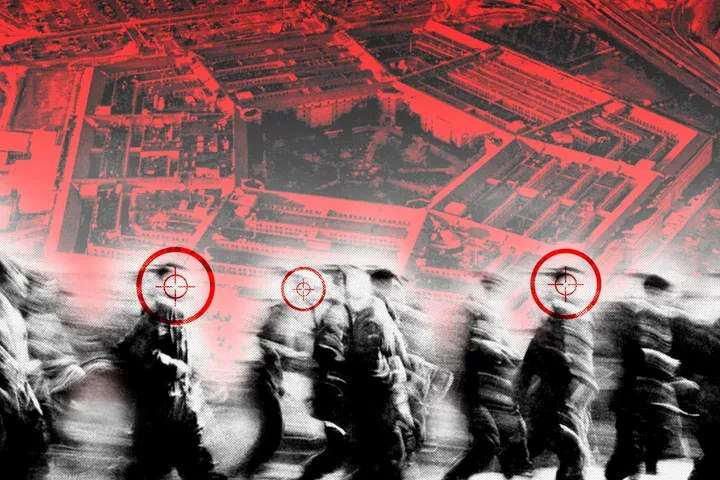
Back in 2018, more than 3,000 Google employees protested their company’s entanglement in “the business of war” after learning Google was part of Project Maven, then an emerging Pentagon initiative to use computer vision to sort through the massive troves of video footage collected by U.S. drones operating overseas. Their core fear was that Maven’s AI would eventually be weaponized for lethal targeting.
As I spent years researching the full history of Project Maven for my book, I confirmed that this fear was fully realized. The program was just as divisive within Pentagon ranks as it was outside of it, but that internal opposition never slowed its progress. Today, the platform known as the Maven Smart System is actively used in U.S. operations against Iran. The transformation of top U.S. military leaders from skeptics of AI in war to true believers traces directly to one Marine colonel named Drew Cukor, the program’s founding leader.
In early September 2024, during cocktail hour at a closed-door private retreat for tech investors and defense leaders, Vice Admiral Frank “Trey” Whitworth sought Cukor out. For the first time, Maven’s creator and his most prominent skeptical successor stood face to face.
Three years earlier, Whitworth had served as the Pentagon’s top uniformed intelligence official, advising the chairman of the Joint Chiefs of Staff and overseeing one of the most sensitive, potentially lethal functions of any military: the targeting process. Cukor, a driven Marine intelligence officer, was wrapping up his five-year tenure leading Project Maven. One of his former senior commanders once described him to me as a “one-man wrecking ball” — a leader willing to challenge military orthodoxy and defense bureaucracy to advance AI warfare, even at his own professional cost.
That first high-stakes meeting between the two men was so tense that onlookers reported shifting uncomfortably in their seats. Whitworth, a demanding former SEAL Team 6 intelligence director who spent nearly two decades on the military’s top targeting committee, grilled Cukor on whether Maven’s AI integration was skipping critical steps in the targeting process, moving too fast and bending long-held rules. “Tell me what happens when we get a bad strike, and we’re sitting in front of Congress answering hard questions?” Whitworth demanded.
He worried about eroded record-keeping and accountability when AI was folded into targeting, and openly questioned whether Project Maven was worth the $1 billion Congress had already allocated to it — much of which had flowed to Silicon Valley’s controversial high-profile startup Palantir. When Whitworth took over the National Geospatial-Intelligence Agency (NGA) in June 2022, and inherited oversight of Project Maven after Cukor’s departure, he still believed the program was overpriced, overhyped, and reckless with the targeting principles he prioritized. Whitworth had the power to shut the program down immediately, and Cukor’s legacy project looked increasingly imperiled. “We were all very concerned,” Cukor told me during our weekly afternoon conversations, which stretched on for more than a year. “Trey was no friend of the program.”
I came to see Cukor as a foundational figure in a war that has not yet fully arrived — a view shared by nearly everyone connected to Project Maven, whether they celebrate or condemn him. Palantir CEO Alex Karp approvingly calls him “crazy Cukor” and names him “the founding father of AI targeting.” After his showdown with Whitworth, Cukor told colleagues: “I will either be famous, or I will live in infamy.”
But now, more than two years into Whitworth’s leadership of NGA and more than two years into Russia’s full-scale invasion of Ukraine, Whitworth has abandoned his skepticism and now praises the program. “Drew, this is important work,” he assured Cukor at the September 2024 retreat. The Palantir-built Maven Smart System, which pulls disparate battlefield and intelligence data into a single digital map and displays AI-generated detections for use in targeting, proved far more adaptable than Whitworth expected. It integrates with any existing military system and evolves with every software update, meeting the exact needs of frontline operators.
Cukor describes Whitworth as a methodical thinker who only endorsed Maven after working through the evidence on his own. Cukor believes Whitworth came around to understanding why the U.S. needs AI integrated into the targeting cycle (he also jokes that NGA’s $250 million annual share of Maven’s budget didn’t hurt). “It speaks to his character, honestly,” Cukor said. “It wasn’t an apology so much as a formal recognition. We didn’t hug, but it was an important conversation.”
Under Whitworth, Maven stepped out of the shadow of the secrecy Cukor maintained after the 2018 Google protests. Where six years earlier, the decision to fire on a target was the longest step in the targeting cycle, today every other step of the process is nearly fully automated and compressed into minutes, making the final human decision to strike the slowest part of the workflow. Internally, the program’s core AI tool is called Maven ATR: automatic target recognition. Publicly, Whitworth now calls Maven his agency’s “marquee targeting program of record.”
A few days after his quiet reconciliation with Cukor, Whitworth took the stage at a live-streamed Palantir customer event. The contrast between the uniformed admiral and the Palo Alto tech crowd could not have been sharper: his service dress blues bore gold buttons, gold braid on his sleeves, and rows of service ribbons, and his polished black formal shoes stood out against a backdrop display of colorful Nike sneakers. His presentation on Maven Smart System came right after talks from two other Palantir clients: one that leases railcars, and another that manufactures automotive seating. War had become just another line of business, slotted between commercial logistics and healthcare supply chains.
Amit Kukreja, a prominent Palantir commentator, investor, and fan of the company’s branded merchandise, narrated the event live for retail investors, calling it a “new and special” moment for members of the public to learn about Palantir’s secretive government work. Even Alex Karp seemed caught off guard. “I didn’t even know we were allowed to talk about this stuff,” he said, after bragging about Palantir’s access to the “most elite and interesting” government clients in the world.
That spring, Palantir had already won a $480 million ceiling Army contract for Maven Smart System, and in September 2024 won a second contract worth up to $100 million to supply the platform to all U.S. military services. By spring 2025, the Pentagon raised the total contract ceiling for Maven Smart System to $1.3 billion, extending the program through 2029. NATO has also signed on as a customer, with 10 member nations already evaluating the platform for their own use. The UK is reportedly set to sign a £750 million (roughly $1 billion) deal for Palantir’s military AI tools during a high-profile state visit by Donald Trump in September 2025.
Onstage at the Palantir event, Whitworth walked through how AI targeting works as a demonstration played on a screen beside him. An icon flashed alerting the audience to “Possible Enemy Activity.” A click revealed a group of Russian tanks on a notional demonstration map of Ukraine’s Kherson region. From detection to destruction, the process took just four clicks. Palantir’s Target Workbench popped up; two more clicks confirmed the tank group’s exact coordinates, and paired the target with an “effector” — in this case, an F-22A fighter jet 82 miles away. One final click, and a green check flashed on screen: “Target destroyed.”
Nearly a year later, on a hot summer day in 2025, I entered NGA’s headquarters at Fort Belvoir Army Base in northern Virginia. It was my second visit to the spy agency’s headquarters, and I wanted to learn why Whitworth changed his mind, how far Maven had spread, and how the program’s new backers weigh the risks and rewards of integrating AI into standard military workflows.
By that time, Whitworth had become such an ardent AI advocate that his agency now produces machine-generated intelligence reports for U.S. policymakers that “no human hands” have touched. NGA also awarded a $708 million contract for data labeling to train Maven’s computer vision models — the largest such contract in U.S. history. The contract went not to Scale AI, founded by self-made billionaire Alexandr Wang, but to Enabled Intelligence, a startup that hires autistic people with specialized expertise in pattern recognition who thrive on repetitive work.
My visit required the full security rigmarole standard for any meeting at a spy agency: thorough background checks and vetting; no phone, laptop, or smartwatch allowed; and one unusual extra step: I had to record not just the make and model of my tape recorder, but its serial number — a detail that left me resolved to never use the device for another interview after my visit.
The building is a temple to geospatial intelligence, or GEOINT, the practice of deriving actionable analysis tied to physical locations on a map. Its blast-resistant facade is wrapped in a mesh of reflective glass held by nearly 2,000 concrete triangles, as if each triangle is working to triangulate a unique location. More than 8,500 personnel work at the headquarters, but I was there to meet four NGA officials deeply involved in Maven’s development, standard-setting, and global expansion. I was told it was unprecedented for all four to gather in one room to brief a journalist on the program, and I was eager to understand what is at stake for them.
“This is our reputation on the line,” Whitworth told me during the interview. After he saw how easily the system integrated into real combat scenarios, it did not take long for him to change his mind: “I started really believing in it.” Far from being sheepish about ushering in the age of AI warfare, the program’s leaders want their names tied to its legacy. One NGA official joked that some had become quite “ornery” fighting over credit for the program. I wondered if NGA was pushing for recognition because advisors to the second Trump administration want to pull Maven and AI oversight away from NGA and back into Pentagon control. “There’s no one person who can claim credit for this thing. It’s too big,” Whitworth said.
The NGA officials walked me through Maven’s growth since the agency took over most of the program two years earlier. Five of Maven’s eight core initiatives, including analyzing drone feeds and satellite imagery, now fall under NGA’s purview. Whitworth wants to expand his agency’s scope and capabilities to match the spread of ubiquitous global surveillance sensors. AI runs on data, and data requires constant global surveillance to collect it. While the NSA listens in on global communications, NGA watches the globe — and Whitworth wants to watch it in constant, minute detail, 24/7. NGA previously gave me a demonstration of how Maven’s AI can flag new military construction in China, such as a new rail depot at a missile base. The agency already tracks all movement at 49,000 airfields around the world. Whitworth even wants to put a new GPS-like navigation system on the moon, and is developing alternative mapping tools that rely on magnetics, gravity, remote sensing, celestial navigation, and elevation to use if GPS is jammed or hacked. “From seabed to space” was the new mantra he unveiled in 2023: the U.S. military seeks omniscience, omnipresence, and omnipotence across the entire planet and beyond.
Nearly two years into Maven’s support for Ukraine, the program was formally designated a “program of record” in early November 2023 — Pentagon-speak for a fully funded, long-term initiative with congressional backing, guaranteed a consistent annual budget for years to come. Oversight remains split: the Pentagon’s Chief Digital and Artificial Intelligence Office, the successor to the original JAIC, pays for Maven Smart System licenses and manages text-based work like parsing captured enemy documents, while NGA builds the computer vision models that appear on Maven’s screens.
Throughout 2024, Whitworth courted new users across the military, calling combatant commanders in every region to walk them through NGA’s latest feature updates for Maven. Responding to criticism I had encountered, he insisted Maven works just as well in the Indo-Pacific as it does in Europe, and can track moving targets just as effectively as fixed sites.
Maven Smart System has seen particularly rapid adoption in the Middle East. General Erik Kurilla, who took over U.S. Central Command (CENTCOM) in April 2022, began using the platform “extensively” to support U.S. airstrikes. He hired former Google AI expert Andrew Moore, and spent most of 2023 running 90-day experimental sprints to practice processing 1,000 targets a day, in partnership with the UK and other allies.
By early 2024, CENTCOM made a “pretty seamless shift” from testing the platform in exercises to using it in live combat, marking the first large-scale U.S. test of AI in active war.
“October 7th everything changed,” Schuyler Moore, CENTCOM’s chief technical officer, told me, referring to the 2023 deadly Hamas attack on Israel that international human rights groups have ruled constitute war crimes and crimes against humanity. “We immediately shifted into high gear and a much higher operational tempo than we had previously,” she said.
Brigadier General John Cogbill, CENTCOM’s deputy director of operations who served under Kurilla including with the 75th Ranger Regiment, put it more bluntly: “It’s just been off to the races ever since.”
In February 2024, CENTCOM used Maven Smart System to locate rocket launchers in Yemen and unmanned surface vessels in the Red Sea. Moore told me Maven’s AI helped narrow down more than 85 targets that U.S. bombers and fighters subsequently struck in Iraq and Syria, in retaliation for the killing of three U.S. service members in Jordan the previous month. It was the first public confirmation that the U.S. military uses AI to identify enemy targets for strike. “We were using these tools in a way that we’d never used them,” Cogbill told a podcast the following month, noting the command became “hyper-focused” on Israel.
By 2024, 179 separate live data feeds from land, sea, air, space, and cyberspace flow into Maven Smart System at CENTCOM, which Whitworth told me uses the platform more than any other command. That region alone has 13,000 registered accounts, with 2,500 regular users who log in “at least a few times a week,” according to Rear Admiral Liam Hulin, a former SEAL Team 3 commander now serving as CENTCOM’s deputy director of operations. Maven can also identify the nearest available weapons, match the best weapon to the target, calculate flight time and weapons loading details, and track the location of personnel and partner forces.
Operators click through Maven’s Target Workbench to approve or reject targets, order them by priority, and send targeting data directly to weapons systems. “Shortening kill chains is universally good,” Cogbill said on an April 2024 podcast.
Kurilla can track all activity in real time even from a plane: he watches live Maven feeds updating the latest developments in Iraq and mapping ship positions across the Red Sea, alongside data from Link 16, the jam-resistant tactical communications network used by NATO and U.S. allies. He would later select Maven as the topic of his lecture at Capstone, the military’s in-house leadership program for newly promoted generals at the National Defense University.
What the command has been able to do with the platform, Kurilla later confided to colleagues, was “eye-watering.”
But major concerns remain. Cogbill gave Maven Smart System a “C+” grade during remarks at an August 2024 conference. AI is improving constantly, he said, but it remains risky due to hallucinations, “all kinds of AI ethics,” and the chance that flawed input data or a biased algorithm could lead operators “to the wrong conclusion.”
Alex Miller, the U.S. Army’s serving chief technology officer during the second Trump administration, who I was told was an early Maven “frenemy,” told me in late 2025 that Maven Smart System uses too much bandwidth to operate below the division level, and risks exposing frontline U.S. troops via electronic signatures from hasty satellite connections. Even so, he has come to see it as a “phenomenal” platform at the theater level, and wants AI integrated into the entire fire control system.
Like a growing number of military leaders inspired by Maven, Miller wants AI built into every weapon and across all tactical levels. Weapons delivery systems need to be digital-first and automated, with AI targeting integrated down to the battery and company level, he said. AI matters because of the “superhuman” speed and scale it brings to combat operations. “It doesn’t matter how many people you throw at the problem; we are never going to solve the challenges of war without technology like AI.”
Kurilla told Congress in June 2025 that user feedback is constantly improving the command’s software suite. I confirmed the U.S. used Maven during the 12-day Iran-Israel war that broke out just five days later. While Maven was not the primary intelligence platform, it was used regularly for operations. A single targeting cell can now go from detecting a target to striking it in minutes, down from hours before the program. Maven can also detect and track ballistic missile launches headed toward Israel. When Iran launched 200 missiles toward Israel in October 2024, Maven’s development team worked overnight to update the program’s digital infrastructure.
NGA officials told me Maven is accelerating operations and “enabling lethality” at combat headquarters around the world. At least 32 separate companies work on the program, and nearly 25,000 U.S. personnel use it. Usage has more than doubled since January 2025, NGA officials told me. The agency has accumulated 1 billion AI detections in its computer vision data store, and the program now detects objects five times faster than it did two years ago.
When I asked how many users actually rely on the AI’s computer vision detections, rather than just using Maven’s data fusion and display platform for a broad battlefield overview, officials quickly defended the AI. The models improved “by leaps and bounds” in 2025, Whitworth told me.
The Untold Story of How Project Maven Went From Skeptic’s Punchline to the Backbone of U.S. AI Warfare