China’s Robot Boom: Is China Set to Lead the Global Humanoid Revolution?
Standing four feet tall in front of me, the humanoid robot honestly looks a little unsteady on its feet—like it’s had one too many. It lurches from leg to leg, arms flailing wildly. After roughly 30 seconds, it suddenly freezes, then strides straight toward me, one arm extended.
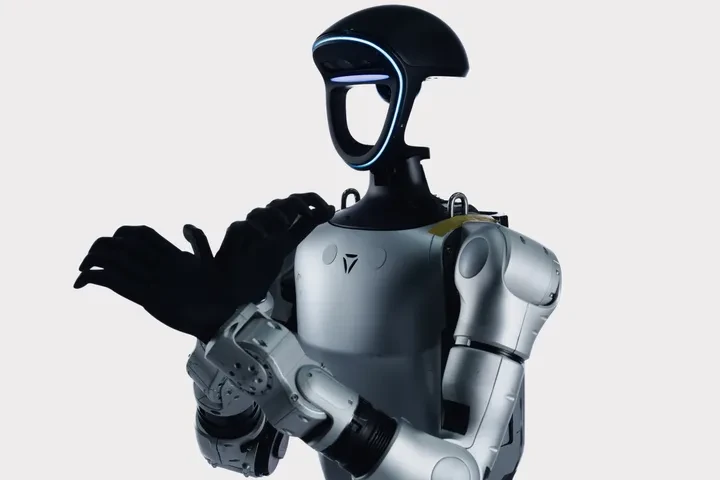
This wobbly bot is one of dozens on display at the World Artificial Intelligence Conference, held on the banks of Shanghai’s Huangpu River. The convention center floor is packed with humanoids of all stripes: dancing bots, box-carrying bots, even bots leading robot dogs on laps around exhibition booths. A handful are slumped motionless in corners, plugged in and recharging their batteries.
It’s a mild July day, and I’ve traveled to Shanghai to explore how China’s AI ecosystem differs from the Western industry I typically report on. Even before I reached the conference, I couldn’t miss the shift: the streets of Shanghai’s chic former French Concession are lined with sleek electric cars from BYD, Xiaomi, and Huawei. At Manner, a popular premium coffee chain, I even tried an avant-garde drink called a sparkling citrus iced Americano. Now, wandering the convention floor, I can easily picture these dancing bots one day walking Shanghai’s sidewalks, toting their owners’ shopping bags.
A crowd has gathered around a small boxing ring, where two humanoids trade punches. One takes a tumble, then pushes itself back up onto its haunches and straightens to face its opponent again. A young staffer invites me to take a swing at one of the bots. I’m pretty sure I’d end up feeling guilty if I hurt it, so I turn her down.
Of course, all the flashy activity on the convention center floor hides a quiet reality. Woven through the crowds, you can spot attendees holding game controllers, issuing high-level commands to the bots. While today’s humanoids can balance on their own and pull off short pre-programmed routines, humans still call the shots: they tell bots which direction to walk, who to shake hands with, and when to execute a backflip. Another major limitation: most humanoids don’t have working fingers. Their arms typically end in blunt stumps, so while they can hold and lift boxes (or slip on boxing gloves), they can’t grasp small, delicate objects.
Even with these current gaps, experts expect humanoid robots to reshape the global workforce and economy in the coming decades. Amazon is already testing humanoids built by U.S. startup Agility, and leaked internal memos show the company expects to replace a large share of its human workers with robots within the next few years. Bank of America analysts project that by 2035, robot manufacturers will ship 10 million humanoids annually. Morgan Stanley forecasts that by 2050, 1 billion humanoids will be in use worldwide—with nearly a third (302.3 million) operating in China, compared to just 77.7 million in the United States.
HANGZHOU
No humanoid developer is further ahead right now than Hangzhou-based Unitree Robotics. While Elon Musk’s Optimus robot still stumbles through public demos, Unitree’s bots already pull off sprints, kung fu kicks, and acrobatic backflips. (The dancing greeting robot at the WAIC conference was a Unitree model.) Unitree’s legged robots are also astonishingly affordable, priced at tens of thousands of dollars or less—one-tenth the cost of a comparable U.S.-built humanoid.
Unitree is China’s most high-profile robotics startup, a national champion for the country’s tech sector, and reports say it’s targeting a $7 billion IPO on the Shanghai stock exchange. And if Unitree stumbles? More than 200 other Chinese companies are also developing humanoids, a boom that recently prompted the Chinese government to warn of overcapacity and redundant research. By comparison, the U.S. is home to only around 16 prominent humanoid developers. With numbers like that, it’s hard not to guess that China will be the first country to put 1 million humanoids into widespread use.
Unitree’s home city of Hangzhou sits roughly 110 miles southwest of Shanghai. The city is best known for its scenic, postcard-famous West Lake, but it’s also a leading tech hub: it hosts e-commerce giant Alibaba, its fintech affiliate Ant Group, and dozens of fast-growing AI startups. Alongside Unitree, there’s DeepSeek, whose open-source large language models have gained a global following.
I planned to visit Unitree along with a handful of other local companies. Unlike many of its competitors, Unitree sells a broad range of legged robots and is already profitable. Unfortunately, the company is largely closed to outside visitors as it prepares for its IPO. I later learned its headquarters shows the signs of relentless testing: the staircase just inside the entrance is scuffed and damaged from years of legged robots practicing carrying heavy loads. “It’s one of the most beat-up places you can imagine,” says Mike Cho, a Singapore-based robotics entrepreneur who has visited the facility. “Everywhere you look, there are broken robots, broken parts, and broken concrete.”
I eventually connected with Unitree CEO Wang Xingxing, who agreed to chat via the messaging app WeChat, citing his limited English. Wang is something of a celebrity in China’s tech scene. In February 2025, he was invited to an event hosted by Chinese President Xi Jinping, alongside other titans of Chinese tech: Alibaba’s Jack Ma, Huawei founder and CEO Ren Zhengfei, BYD chairman and CEO Wang Chuanfu, and Xiaomi CEO Lei Jun. I’d already seen Wang deliver a rapid-fire keynote speech at the Shanghai WAIC conference, where he told the audience he aimed to build robots capable of “serving tea, working in factories, or even performing on stage.”
Over WeChat, he told me he’d been fascinated by robots since childhood. During his first year of college, he built a small two-legged robot on a budget of just 200 RMB, or around $28. “The moment I saw the robot I designed come alive,” Wang wrote, “the sense of achievement from combining technology and creativity made me determined to devote my career to robotics research.”
As a master’s student at Shanghai University in 2015, he built a small four-legged robot for less than 20,000 RMB (about $2,800). The project went viral on Chinese social media; people were shocked that a student could build such a stable, low-cost robot. He worked briefly for drone giant DJI before securing a small round of seed funding and founding Unitree in 2016. The company launched its first product, a four-legged robot dog called Laikago, in 2017.
Wang admits that early on, Boston Dynamics and its four-legged Spot robot were a major inspiration. Gavin Kenneally, CEO of U.S. robotics firm Ghost Robotics, remembers seeing Laikago at industry trade shows and conferences. “Their robot really wasn’t very capable back then,” he told me. But while Boston Dynamics sold Spot for $75,000, Laikago was priced at just $25,000.
In 2019, a team at MIT developed an electric motor that let their quadruped robot Mini Cheetah hit record-breaking speeds. Less than a year later, Unitree unveiled a new four-legged robot called A-1. “It was basically an exact copy of the MIT Mini Cheetah,” Kenneally says. “It was a huge leap forward from their previous design.”
After that, Unitree’s business took off. According to consulting firm SemiAnalysis, Unitree’s quadruped robot sales in 2023 were 10 times higher than Boston Dynamics’. The company sold nearly 24,000 quadrupeds, which are used for inspections and security patrols on construction sites, oil rigs, and factory floors—roles where their ability to climb stairs and navigate rough rubble makes them ideal.
Take apart a Unitree robot, and you immediately see the advantage of China’s tightly integrated manufacturing ecosystem, where close supplier relationships can make or break a robotics firm. SemiAnalysis analyzed one configuration of Unitree’s newest quadruped, the Go2, which retails for around $8,000. The firm found that all of its core components—sensors, motors, gearbox, battery, onboard computer—cost just $3,272 total. (Other Go2 configurations are priced as low as $1,600.) “What they’ve done is iterate extremely quickly, leveraging Chinese manufacturing and supply chains,” Kenneally told me.
Wang never limited his focus to robot dogs, either. Boston Dynamics had been working on its Atlas humanoid for decades. By 2023, Elon Musk was generating huge buzz around his own Optimus humanoid, and Wang began developing his own humanoid model that same year. In August 2023, Unitree launched its first humanoid, the H1. Less than a year later, the company began selling the more advanced G1, priced at just over $13,500 for academic researchers. This past summer, it unveiled an even cheaper (though less capable) humanoid called the R1, which sells for just 39,999 RMB ($5,700).
During his WAIC keynote, Wang hinted that a revolution in robotic intelligence is just around the corner. “The ‘ChatGPT moment’ for robots will arrive when a robot can enter an unfamiliar room, bring a person a bottle of water, or tidy up completely autonomously after a single simple command,” he told attendees. “This could happen in as little as one to three years, and at most three to five.”
Plenty of roboticists agree that the field will reach its “ChatGPT moment” soon enough, though there’s little agreement on what exactly that milestone will look like. Still, it’s clear Wang is far more optimistic than most. At a recent major robotics conference in Hangzhou, a panel of experts polled the audience on whether humanoids would take over most human jobs by 2050. Wang was one of the few who voted yes.
BEIJING
I rushed to catch a flight to Beijing to visit another organization working toward robotics’ ChatGPT moment. The Beijing Academy of Artificial Intelligence (BAAI) is a non-profit research institute founded in 2018 by the Beijing municipal government to coordinate national AI research. From a window in BAAI’s robotics lab, located on an upper floor of a low-rise office building, I can see the sprawling campuses of Tsinghua University and Peking University, two of China’s most elite academic institutions.
Despite its academic focus, BAAI has drawn scrutiny from the U.S. government. In May 2025, the U.S. Commerce Department added BAAI to its Entity List, banning the institute from purchasing American technology. The U.S. accuses BAAI of “attempting to acquire U.S.-origin items in support of China’s military modernization,” though BAAI staff insist the institute is purely a civilian research lab.
At the institute, I saw another dancing Unitree humanoid. This bot dropped into a wide stance, then stomped its feet and pumped its fists in time with a music beat. I hadn’t seen this routine at the Shanghai conference, and there’s a reason for that: this humanoid uses an experimental AI training approach, where the model learns movement by watching humans—specifically, dance clips from Douyin, China’s version of TikTok.
Zhongyuan Wang, BAAI’s president and head of its robotics division, told me about the institute’s new open-source robotics model, Robobrain 2.0, which engineers built to combine a large language model’s natural language abilities with spatial reasoning. Robots have yet to fully leverage the broad capabilities of LLMs, and the team hopes Robobrain 2.0 will help robots operate in unplanned, unfamiliar environments and communicate more effectively with humans. In one test, BAAI researchers used Robobrain 2.0 to control a pair of robot arms. When the model heard a human say “I’m hungry, make me a burger,” it translated the request into a sequence of actions that commanded the arms to place lettuce and a patty into a bun.
But language models can only do so much. What robots need most right now is a new kind of AI model that understands the physical world as intuitively as an LLM understands written text. And to build that model, engineers need vastly more training data than they have today. Walking through BAAI’s lab, I saw dozens of researchers sitting at desks, remotely operating robot arms and grippers to teach algorithms simple manipulation tasks: sweeping beans off a table, pouring liquid from a pitcher into different cups, picking items off shelves. A young researcher wearing a VR headset is making tea, while a camera records every movement to use for training. The idea is that with enough training data, robots will eventually be able to intuit how to complete all kinds of tasks without explicit, task-specific programming.
The problem is, no one is entirely sure what kind of data is most useful for training physical robots, let alone how much data is needed or the best way to collect it. And for humanoids to become truly ubiquitous, engineers also need to invent new hardware that can replicate the dexterity of a human hand. For a robot, doing a backflip is far easier than flipping a coin.
Even so, Tony Zhao, co-founder and CEO of California-based startup Sunday Robotics, told me he worries that U.S. firms like his don’t stand much of a competitive edge against Chinese companies, which can deploy far more human workers—like BAAI’s team of teleoperators—to train robot models and roll out new hardware quickly. “The U.S. is losing ground when it comes to iteration speed,” he says. “And honestly, I don’t know how we can catch up.”
To try to compete, Zhao recently hired an executive from a Chinese robotics firm with deep experience navigating China’s vast, complex supply chain. “The only way we can beat Chinese companies is to build a China-based team,” he says.
Some U.S. CEOs, including Google DeepMind’s Demis Hassabis and Physical Intelligence’s Lachy Groom—both of whom are also chasing robotics’ ChatGPT moment—told me they expect robotics development to follow a similar path to smartphones: China will build the hardware, while the U.S. will develop the AI “brains.” (Of course, that pattern is already shifting, as Huawei now makes both cutting-edge hardware and software.)
Agility Robotics co-founder and chief robot officer Jonathan Hurst suggests the solution may be for the U.S. government to step in. Hurst, whose company builds humanoids, says the U.S. needs heavy investment in advanced domestic manufacturing, including tax incentives for companies that deploy robots in their warehouses and factories, to support U.S.-based robotics firms. That strategy would mirror the Chinese government’s long-term, patient capital investment in its domestic tech industries. “We have to be very strategic about automation,” he says. “It’s the only way.”
My Beijing hotel, located in Zhongguancun, Beijing’s high-tech hub, didn’t have any of the wheeled service robots that deliver items to guest rooms at many major urban hotels. Instead, it had a consistently polite human staff member named Stephen. When I needed a shirt cleaned, Stephen turned the job around in just a few hours. As I flew home at the end of my trip, I thought about how many human hands had washed, pressed, packaged, and returned my shirt that quickly. Even in China, the robot revolution hasn’t replaced human workers yet.
What Do You Think?
Share your thoughts on this article in the comments below. Or, you can send a letter to the editor at [email protected].
China’s Robot Boom: Is China Set to Lead the Global Humanoid Revolution?