The End of Sierra: The Life and Death of a Once-World-Fastest Supercomputer
It was the U.S. government that made the final call: it was time for Sierra to be decommissioned. To be clear, Sierra was a supercomputer—so she was never biologically alive to begin with. But by any objective standard, her 7 years of operation made for an extraordinary legacy. Housed at Lawrence Livermore National Laboratory in Northern California, Sierra resided in the lab’s computing complex inside Building 453, cared for full-time by a team of dozens of staff. She wrapped up her final scheduled projects in October of last year, before going permanently offline.
According to TOP500, the organization that ranks the world’s most powerful supercomputers, Sierra once held the title of the second-fastest supercomputer on the planet. Her origins stretch back more than a decade, to a technical workshop for U.S. national lab officials held in a Chicago hotel conference room. A purpose-built machine from start to finish, Sierra was constructed from thousands of IBM Power9 CPUs and Nvidia Volta V100 GPUs—a bold, unconventional architecture for Livermore at the time.
Like all top-tier supercomputers, Sierra was massive. She was made up of thousands of individual compute nodes, stacked inside server racks—essentially large cabinets that held her core processing hardware. All told, 240 of these racks filled roughly 7,000 square feet of lab floor space. All that power was dedicated to her core mission: running highly classified, specialized simulations for the U.S. National Nuclear Security Administration. Even when her decommissioning was ordered, she still held a respectable 23rd spot in global supercomputer speed rankings.
Why Retire a Still-Functional Supercomputer?
So why did Sierra need to be shut down for good? After all, building her required an enormous investment of time, money, and expertise. Lab leadership has never confirmed her total construction cost, but she was undeniably expensive: the government spent at least $325 million on both Sierra and her fraternal twin, Summit, a supercomputer hosted at Oak Ridge National Laboratory in Tennessee. (Summit was decommissioned in late 2024.) What’s more, Sierra was still fully operational when the decision was made.
“When a machine reaches the end of its service life, it’s easy to think, ‘We’ve already sunk all this money into it—we should just keep running it forever,’” says John Allen, the lab’s organizational information security officer. “But that’s wrong. Her good, faithful service is over, and we have to move on.”
There are several well-documented reasons to retire aging supercomputers. First is the natural lifespan of hardware: even new, factory-fresh components can come with hidden defects, so turning on a new supercomputer immediately starts a process of identifying flaws and swapping bad parts. After that break-in period, the machine enters its prime with low failure rates. Over time, though, most chips wear down, and failure rates climb again. This U-shaped pattern of failure (high when new, low in middle age, high at end of life) is what IT professionals call the “bathtub curve,” and labs have strong incentive not to let machines reach that final high-failure phase.
“Just like humans, as hardware ages, you get more ‘illnesses,’” explains Devesh Tiwari, a high-performance computing researcher at Northeastern University. “You fail more often, so you need far more maintenance and care to keep running.”
A closely related issue is obsolescence, which impacts both hardware and the operating software that runs the machine. Over time, replacement parts become hard, or even impossible, to source. Neely notes that Sierra never reached the final failure phase of the bathtub curve—but she was getting close. Neither IBM nor Nvidia still produces her components, and IBM no longer supports the version of Red Hat Enterprise Linux that Sierra ran.
“It really all comes down to resources,” says Ann Dunkin, former chief information officer of the U.S. Department of Energy, which oversees the national lab system. “If they had infinite resources, they would run infinite supercomputers.” For modern supercomputers, a 7-year operational lifespan is fairly standard.
But the biggest threat to Sierra’s continued operation was her successor: El Capitan, a newer, far faster supercomputer that was once her next-door neighbor in the lab. To the untrained eye, the two look nearly identical: both are long rows of whirring racks connected to massive power supplies routed under the floor. But the difference is all in the internal hardware. While Sierra’s components were cutting-edge in her day, El Capitan came online in 2025 built around AMD’s Instinct MI300A APU, with unified shared memory across its CPUs and GPUs. Running El Capitan requires up to 36 megawatts of power, compared to Sierra’s 11 megawatts—enough, the lab says, to power 36,000 average-sized U.S. homes.
Supercomputers are measured in a few ways, but the core metric is floating-point operations per second, or flops: faster flops equal a more powerful machine. At her peak, Sierra could hit 94.64 petaflops (94.64 quadrillion floating-point operations) per second. El Capitan hits 1.809 exaflops, making it roughly 19 times faster than Sierra. In late 2025, El Capitan was officially named the fastest supercomputer in the world. For the lab, Neely says, Sierra’s remaining power was no longer worth the cost of keeping her online.
The Slow, Careful Process of Decommissioning
Retiring Sierra didn’t involve a dramatic big red button or giant lever to flip. While cutting her power cords would have worked, that’s not the safe, recommended procedure. First, scientists who used Sierra were notified via email to save all their work. Next, a formal “do not resuscitate” order was put in place: no more replacement parts would be installed if something broke.
Decommissioning proceeded in stages: teams started with compute nodes and rack switches, leaving management nodes for last because they are needed until the very end. Technicians first run digital scripts that shut the computer down layer by layer, then flip physical power switches off permanently. Next comes what insiders call “dehydration”: when Sierra was active, she generated massive amounts of heat, so the lab pumped thousands of gallons of water per minute through under-floor pipes to keep her cool. All that water had to be drained before dismantling, and safety teams tested it first to confirm its pH was environmentally safe before disposal.
Some supercomputers get far more dignified retirements than full dismantling. A small number are donated to other research institutions or put on display in museums. In 2024, for example, the General Services Administration auctioned off Cheyenne, a petaflop supercomputer built by Silicon Graphics International, after its retirement. But the reality is that there is very little demand for used top-tier supercomputers, and most are stripped for parts before the rest is destroyed. Back in 2013, when no institution wanted to buy the entire Encanto supercomputer in New Mexico, officials took it apart and sold it piece by piece. Argonne National Laboratory tried to donate most of Intrepid—once the world’s third-fastest supercomputer—to other labs and a computer museum, but got very few takers; aside from a small number of racks that went to North Carolina State University, the rest was recycled.
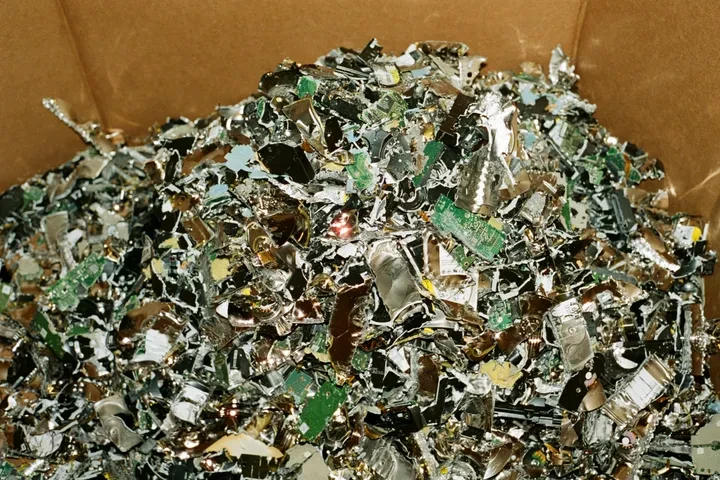
Sierra is being recycled under strict security protocols: because she supported the U.S. nuclear stockpile program, she was full of classified data, and cannot simply be thrown away as scrap. Every component must be destroyed completely to eliminate any risk that part of the machine could be reactivated to recover state secrets. Staff wearing gloves remove individual nodes and extract all lithium-ion batteries, which are sent to a specialized battery recycler. Other components, including system boards, processors, and the metal racks that held Sierra together, are shipped offsite for coarse shredding. Any non-recyclable material is destroyed after a thorough data security review.
Flash memory can retain data even when unpowered, so these components are ground into an extremely fine powder. For magnetic drives, the lab uses a special, government-approved degausser that uses a permanent magnet to completely wipe all data—so strong it can erase nearby credit cards and interfere with sensitive medical devices.
The entire process takes a few months, and will be nearly complete by the time this article publishes. The final step is for electricians to permanently sever Sierra’s power connection. After that, she will be completely gone, except for the existing under-floor cooling and power infrastructure, and earthquake-resistant structural foundations, which will be reused for whatever new machine takes her place.
Saying Goodbye
There is no standard protocol for saying goodbye to a supercomputer, no official rulebook to follow. Back in 2006, Livermore scientists held a formal retirement party for ASCI White, an older IBM supercomputer. Neely recalls that researchers who used the machine regularly were invited to flip small power switches after a group countdown—even though the machine had already been powered down. At the end of the event, everyone ate cake. That same year, a similar ceremony was held in Albuquerque for Sandia National Lab’s ASCI Red, which also featured cake: decorated with purple flowers, silver ribbons, and a simple message in icing: “Adios ASCI Red.”
Multiple people interviewed by WIRED said they do feel sadness when long-used supercomputers are retired, noting that the loss hits hardest the researchers who use the machines daily, not the IT teams that maintain them. “I never got emotionally attached to any of the hardware I’ve worked with,” says Larry Baca, a systems engineer at Sandia National Laboratories who has packed up dozens of retired supercomputers over his career.
Horst Simon, a supercomputing expert who helps run the TOP500 ranking project, agrees there is little reason for grief. “While individual supercomputers will die,” he says, the field of high-performance computing is “very much alive.”
That cycle of birth and retirement could change one day, experts say. There are two possible end points for the current model: one day, it may be so easy to integrate new hardware with old software and vice versa that there will be no need for entirely new supercomputers—we will just keep upgrading the same machine with better parts indefinitely. The other, less optimistic possibility is that we will eventually run out of faster, more powerful chip designs to justify building new machines, as many experts already worry that Moore’s Law is slowing down significantly.
For now, though, Sierra’s end will clear space for another new supercomputer that will take over the same lab floor where she once stood. “It’s just a normal part of life,” says Allen. “It’s like when your old cat or dog gets really expensive to care for, takes up a lot of your time, and has a lot of health problems, right? Eventually you have to have that difficult conversation.”
What Do You Think?
Share your thoughts on this article in the comments below. Alternatively, you can submit a letter to the editor at [email protected].
The End of Sierra: The Life and Death of a Once-World-Fastest Supercomputer