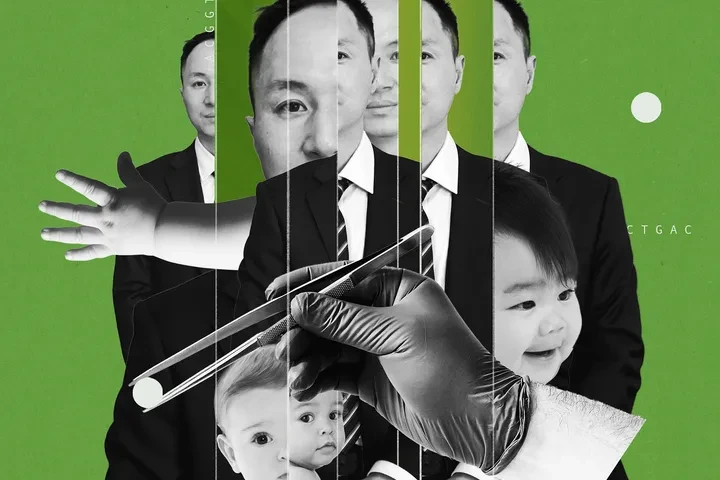
The Return of He Jiankui: After Prison, the Creator of the First Gene-Edited Babies Plans His Next Experiment
In 2018, an visibly anxious He Jiankui stepped to the podium at a scientific conference in Hong Kong. As the packed room fell dead silent, the soft-spoken Chinese researcher adjusted his microphone and confirmed the rumors spreading through global media: he had created the world’s first gene-edited human babies.
Three baby girls were born with modified genomes engineered to protect them from HIV infection. The DNA changes He introduced are permanent and heritable, meaning they can be passed down to all future generations of the girls’ families.
A Chinese court later sentenced He to three years in prison, and the Chinese government implemented a full ban on germline genome editing for reproductive purposes. Now, free from custody, He is working to rebuild his career and rebrand himself as a visionary out to reshape human history.
Since his release in 2022, He says he has developed a gene therapy for Duchenne muscular dystrophy, a rare, deadly muscle disorder that mostly affects boys. He has not published or shared any of his results publicly, but claims a pharmaceutical company has acquired rights to his Duchenne research, and that funders have lined up to support his work. Operating out of an independent lab in southern Beijing, He has recently returned to his original focus: human embryo editing, this time targeting edits to prevent Alzheimer’s disease. Since heritable germline editing is banned in nearly every country, including the United States, He’s path forward remains entirely unclear.
He has documented every step of his post-prison comeback on social media. He has opened up publicly about his failed relationship with Cathy Tie, a Canadian former Thiel Fellow and co-founder of a human embryo editing startup who calls herself a “biotech Barbie.” As a condition of this interview, He required WIRED to refer to him as a “pioneer of gene editing”; on X, he has used far more provocative labels for himself: “Chinese Darwin,” “Oppenheimer in China,” and “China’s Frankenstein.”
He often posts photos of himself in a crisp lab coat, posing alone next to scientific equipment. One widely shared shot of a starkly empty lab is captioned “I did not violate ethics, I overturned it.” More recently, he dropped the austere scientist aesthetic to share a fantastical edited image: he sits on a giant stone throne, prehistoric animals at his feet, a rainbow shining down on his crown, and a double helix embroidered on his purple royal robe.
WIRED spoke with He about the gene-edited babies he already created, and his plans to produce more. This conversation has been edited for length and clarity.
Emily Mullin: Back in 2018, the global scientific consensus was that gene editing for human reproduction was not a mature, safe technology. Do you think it is mature now?
He Jiankui: Any time someone is the first in the world to do something new, no one can call it mature at the start. When the Wright brothers flew the first airplane, was that technology mature? Of course not, but they still made history.
I’m lucky that Lulu, Nana, and the third girl are all healthy and normal. We’ve monitored them for seven to eight years now. So I think it’s time to move forward and create hundreds of gene-edited babies. We should run a trial with roughly 300 embryos right now.
Mullin: Do you keep in touch with the parents of the three girls?
He: Yes, we have regular contact.
Mullin: And everything is fine with the girls?
He: Yeah, they’re in primary school now. Their families are very happy with how things are.
Mullin: Have their parents told them they are gene-edited?
He: No.
Mullin: What is your new lab focusing on?
He: The new lab works on germline gene editing—embryo gene editing—and our main focus is developing edits to prevent Alzheimer’s disease.
Mullin: What gene are you targeting for this work?
He: The APP-A673T mutation. This mutation was first discovered in an Icelandic population. People who carry this mutation never get Alzheimer’s, and they even live longer, on average. They’re completely healthy and normal. So we want to introduce this mutation into embryos, so the next generation will have the same protection and avoid Alzheimer’s.
Mullin: Are you currently working with human embryos?
He: For now, we haven’t started working with embryos yet. We’re still running experiments on human cell lines.
Mullin: And you’ve been doing this work for the past couple of months?
He: Yes.
Mullin: Why are you more interested in embryo editing than developing gene therapies to treat existing patients?
He: Because this work is going to change the world.
Mullin: Where does your funding come from?
He: Donations and early seed money from private supporters. I don’t seek out investors—they come to me. Almost every week, an investor travels to Beijing to meet me for dinner, wanting to invest in my work or pitch business ideas. They come from all over: Canada, Russia, all kinds of places.
Mullin: How much have you raised so far? Do you get any government funding?
He: 50 million yuan, or around $7 million. No government funding at all.
Mullin: And you’re hoping to raise more?
He: I need $10 million total. With that money, I can finish the Alzheimer’s work—from cell lines to mice to non-human primate studies. And even a small-scale clinical trial.
Mullin: You mentioned on X that a patient donated money to your work. Can you share any details?
He: Oh yes, that donor is a CEO of a large company. His family has a history of this disease.
Mullin: Do you mean Alzheimer’s, or another disease?
He: I can’t disclose that. It’s the patient’s privacy.
Mullin: Is it fair to say your funders are wealthy people who want their own future babies to have protective genetic traits?
He: No.
Mullin: How many people work on Alzheimer’s research in your lab?
He: Just me plus two or three other people.
Mullin: Given your criminal history, are you allowed to run a clinical trial in China?
He: Germline gene editing is currently banned in China, so all the work I do in Beijing is limited to human cell lines, mice, and monkey embryos—then I stop. I originally wanted to open a lab in Austin, Texas, to continue embryo editing research, but I don’t have a valid passport.
So my new plan is to base my preliminary work in Hong Kong. But any human trial has to happen somewhere else. South Africa made this kind of work legal last year.
[Editor’s note: In August 2025, South Africa revised its national ethics guidelines, removing language some had interpreted as potentially permitting heritable human genome editing.]
Mullin: Do you think South Africa would be receptive to hosting your work?
He: I’ve already talked to contacts in South Africa, and they showed great interest.
Mullin: Are you allowed to leave China?
He: It is possible.
Mullin: You have condemned IQ enhancement through gene editing, but some critics see editing embryos to prevent Alzheimer’s as a form of enhancement. Where do you draw the line between disease prevention and enhancement?
He: Recently, some billionaires in Silicon Valley have pushed forward to enhance IQ in babies. I think that is a Nazi eugenic experiment that should be stopped. Any scientist who works on IQ enhancement for billionaires should be arrested. Work on Alzheimer’s or HIV is purely to prevent disease, never to enhance a person’s traits.
Mullin: How many years away are you from trying to create babies edited for Alzheimer’s protection?
He: I need two years to finish mouse and monkey studies and initial human embryo research. Then we wait for regulatory approval in South Africa. If the U.S. allows it, we could go to America, or Japan.
Mullin: We’ve already seen animals created from heavily edited embryos recently, like the de-extincted dire wolves revealed in 2025, and gene-edited pigs for human organ transplants. Do you think it will one day be possible to do multiple safe genetic edits to a human embryo?
He: That’s exactly what we’re developing in my lab. We want to make 12 safe edits in one embryo. If we can do multiple edits to prevent cancer, Alzheimer’s, heart disease, HIV, and other major conditions—if we can build a panel of 10 to 20 edits that block all today’s leading killers—children born from these embryos will be much healthier and likely live longer than we do.
Mullin: This research is very controversial to many people. How do you plan to avoid conflict with Chinese authorities?
He: Just be open, transparent, and do the right thing. I post my research plans on social media, so everyone knows what I’m doing. My lab is open too, it’s not a secret. People can come visit. Unfortunately, it’s not open to foreigners anymore due to national security rules.
Mullin: Have you had interactions with the Chinese government since your release from prison?
He: I’m not going to go against the law.
Mullin: You became instantly famous when the babies were born, then served time in prison, and now you’re back continuing your work. What’s the most important thing you’ve learned through this whole experience?
He: The most important rule is: make sure the patient is happy, make sure your work improves their health or well-being. That’s the number one requirement for any medical research. You don’t need to worry about ethics debates, national geopolitics, or any of that other noise.
What Say You?
Share your thoughts on this article in the comments below. Alternatively, you can submit a letter to the editor at [email protected]
The Return of He Jiankui: After Prison, the Creator of the First Gene-Edited Babies Plans His Next Experiment