Op-ed: ICE’s Military Cosplay Fails Even Basic Military Standards
As a combat veteran of the post-9/11 war on terror, I’ve spent the past year observing U.S. Immigration and Customs Enforcement (ICE) expand its domestic operations to an unprecedented scale, all while leaning into a deliberate, performative pseudo-military identity. From issued gear to weaponry to operational tactics, ICE and other federal immigration enforcement agencies have worked overtime to frame themselves as frontline combat troops carrying out a wartime mission. Just look at comments from White House border czar Tom Homan last week, when he described Minneapolis as a “theater of operations” for his agents.
Even though ICE is explicitly not a branch of the U.S. armed forces—it is a civilian law enforcement agency, full stop—it makes sense to analyze its work through a military framework to unpack its real strategic implications. If an agency wants to cosplay as a military force, it is only fair we hold it to military standards of effectiveness and ethics.
Gear and tactics are supposed to fit the mission (ICE’s never do)
Let’s start with the basics of any functional fighting force: equipment, uniforms, and weaponry. For military units, matching gear to the specific mission at hand is non-negotiable doctrine. An infantry squad does not head into a jungle campaign kitted out for urban close-quarters combat. For years in Iraq and Afghanistan, frontline troops often swapped full battle dress for more casual uniforms on counterinsurgency missions, where building trust with local populations mattered far more than looking ready for a world war. When a show of force was required, units adjusted their posture accordingly. Gear, weapons, and tactics shift to fit the job.
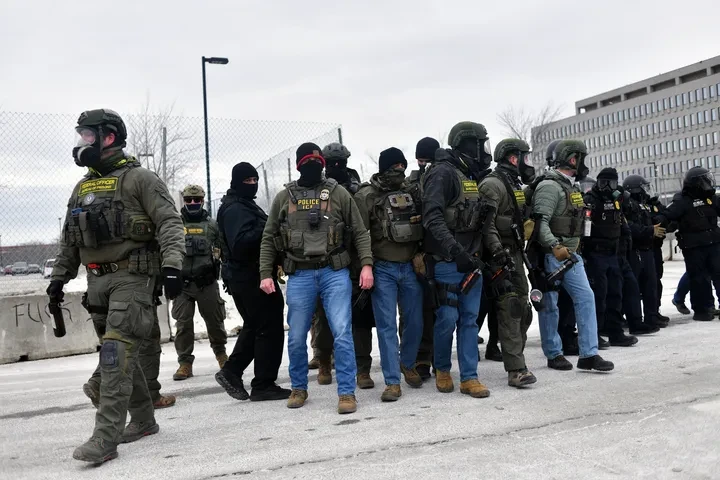
ICE agents—remember, these are civilian law enforcement officers, not frontline enemy hunters—almost always arrive at immigration raids decked out like they’re about to storm the battle-hardened insurgent-held neighborhoods of 2004 Fallujah, facing off against an enemy armed with machine guns, mortars, and suicide vests. Their uniforms are a chaotic hodgepodge too: civilian hoodies, surplus military gear, opaque face masks, that leave bystanders and even local police with no way to confirm they are legitimate law enforcement, rather than unidentified armed assailants.
Where military units tailor their firepower to the actual threat, ICE routinely carries gear and weapons completely disproportionate to the work of routine search-and-seizure and arrest operations. Agents show up with ballistic helmets, bulletproof plate carriers, ammo pouches strapped to their legs, and rifles loaded down with every available aftermarket attachment: high-end optics, silencers, and add-ons that most regular infantry soldiers would never carry, because the extra weight only makes the weapon less maneuverable and less effective in a real firefight.
When it comes to tactical execution, ICE’s approach has zero connection to the actual threat posed or the goal of the operation. For starters, there is no “enemy” here: ICE targets people who may or may not have violated U.S. civil immigration law, most of whom have never indicated any intent to resist with lethal violence. Even so, ICE arrives with an overwhelming, intentionally intimidating show of force that frequently sweeps up innocent bystanders and maximizes the media shock of their actions.
On a basic level, ICE agents operate with none of the core tactical discipline the military drills into every soldier. They cluster tightly around targets and crowd in doorways; in an actual combat zone, that kind of grouping would get an entire team killed by a single grenade or burst of automatic fire. That poor formation also reveals how little clarity most agents have on their own mission orders. Soldiers are trained to disperse, maintain constant 360-degree situational awareness, and only point their weapons at targets they intend to shoot. ICE agents regularly brandish weapons at uninvolved bystanders. While the military trains to only use lethal force against confirmed hostile threats and prioritize preserving innocent life whenever possible, ICE and other federal immigration agents have publicly killed two unarmed U.S. citizens in recent years.
Photos of ICE raids often show agents “stacking” outside a door, the standard close-quarters combat formation used by military and SWAT teams to clear rooms. But far from matching the disciplined formations used by actual combat units, ICE’s tactics look more like they were copied from action movies, TV shows, or first-person video games. That’s not a surprise: average ICE officer training has shrunk to just six and a half weeks, so pop culture may well be their biggest source of tactical “knowledge.” This makes clear that ICE isn’t moving with an actual tactical purpose—they’re just doing what they think looks intimidating and dramatic on camera.
Even when it comes to ICE’s core job—apprehending and detaining people—their approach is routinely chaotic. Body camera and witness videos show agents crowding together, milling around with no clear direction, and frequently targeting innocent bystanders who get in their way. They smash windows randomly, leave unoccupied vehicles idling on the side of public roads, and operate in a style one Maine law enforcement sheriff summed up as “bush-league policing.” Military search and seizure operations are deliberately precise. Every member of the squad has a clear, defined role: some establish an outer cordon to secure the area, one searches the detained person, another oversees prisoner security, another logs all evidence found, all to cut down on confusion and maintain operational integrity.
The lesson the war on terror taught us that ICE ignores
Twenty years of counterinsurgency operations in Iraq and Afghanistan taught us one clear, hard lesson: unnecessary escalation of force almost always creates more violence, not less. Frontline units consistently found that prioritizing de-escalation cut down on civilian casualties, which in turn made local communities far less likely to support insurgent groups attacking coalition forces, ultimately reducing troop casualties. Unprovoked escalation, by contrast, routinely undermined U.S. strategic goals. As a result, U.S. military units are trained to prioritize de-escalation whenever possible, while retaining the ability to respond with proportionate, decisive lethal force to anyone who initiates violence.
ICE tactics almost never prioritize de-escalation. Instead, they ramp up tension through threats, intimidation, and physical assault. These tactics mirror the worst excesses of U.S. counterterror operations that left deep, generational bitterness and anger among local populations in the Middle East. Repression, humiliation, and the killing of innocent family members—whether accidental or deliberate—drove more new recruits into al Qaeda and the Taliban than any other factor.
This brings us to the connection between ICE’s bad tactics and their larger strategic purpose. Military strategy is broadly defined as the alignment of tactics (the ways you act) and resources (the means you use) to achieve a clear political end. If we evaluate ICE’s tactics as the means to a strategic goal, the conclusion is either deeply confusing or deeply chilling. It’s confusing if the stated goal—growing deportation numbers while retaining public support—is taken at face value, because ICE’s aggressive tactics are clearly counterproductive to that end. It’s chilling because ICE’s approach aligns perfectly with one authoritarian strategy that military strategists have long studied: the strategy of control.
This strategy, commonly employed by authoritarian regimes like China and Russia, spans multiple domains of irregular conflict: information warfare, psychological warfare, and legal warfare (often called “lawfare”), to name just a few. While control strategies can target external enemies, they are also frequently used to subdue domestic populations. A control strategy uses deliberate, intimidating repression to prompt violent pushback, which the regime then uses to justify harsher subjugation and to change laws that expand the definition of crimes like terrorism and treason, expanding state power. Regimes use the resulting chaos and public distraction to advance their other unpopular policy goals. In short, it’s a strategy of governing by manufactured crisis.
As the saying goes, war is the continuation of policy by other means—and state-backed domestic violence is no exception. White House policy chief Stephen Miller has repeatedly pressured ICE agents to escalate their tactics and increase arrest numbers, and explicitly told agents they had “federal immunity” from any local accountability for their actions. Since that comment in October 2025, ICE tactics have grown markedly more aggressive. But history shows that domestic populations—especially in states like California, Illinois, Oregon, Minnesota, and Maine that have pushed back against federal overreach—do not tolerate prolonged abusive behavior from federal authorities.
If the political goal of these tactics is not to sow widespread mistrust, confusion, anger, and deep division across the country, then they are badly misaligned and misapplied. Tactics that are disconnected from a clear, just strategic end always lead to strategic failure. In this case, the backlash against ICE’s tactics puts the Republican Party’s hold on Congress and the White House at serious risk.
We cannot normalize military tactics on American streets
At the end of the day, no matter how hard ICE works to sell its militant, combat-ready image, it remains a branch of U.S. civilian government, not a military force. It is not fighting foreign enemies of the United States on our domestic soil. It is critical that we never forget that, and that we push back against the normalization of military-style tactics on American streets.
ICE agents and U.S. military service members do share one real, meaningful common bond: we all swore an oath to support and defend the Constitution of the United States. The U.S. military honors that oath every day. ICE flouts its commitment to the Constitution for all the public to see, every single day on our news feeds and screens.
For me, ICE’s current operations feel like a fever dream: the worst excesses of the war on terror coming home to roost. We have ineffective facial recognition tools that routinely misidentify people (does anyone remember BATS and HIIDES?), gear-obsessed agents who spend more time shopping at military outfitters than training at the firing range, late-night raids targeting supposed “terrorist leaders” who turn out half the time to be just ordinary people trying to get through their workday. We brought the tools of a surveillance state with us to the Middle East, and those tools snuck into our duffel bags and followed us home. We prioritized “accomplishing the mission at any cost” and created a generation of officials who never question orders. We drove heavily armed convoys through neighborhood streets abroad, and now those same trucks roll through our streets at home.
My generation grew up at war. We volunteered, I know that, but we did it with the quiet belief that we were doing good, that our work mattered, that we stood for something important and unique. But now we watch the least effective, most morally corrosive tactics we used abroad brought home and deployed against our own communities, and we are left with a deep, profound sense of betrayal. That betrayal, too, is the product of tactics stripped of any just strategic purpose.
The author writes under a pseudonym out of fear of retaliation from the Trump administration.
Share your thoughts on this op-ed by submitting a letter to the editor at [email protected].
Op-ed: ICE’s Military Cosplay Fails Even Basic Military Standards