The Hidden Legal Crisis of Gaza’s Missing Thousands
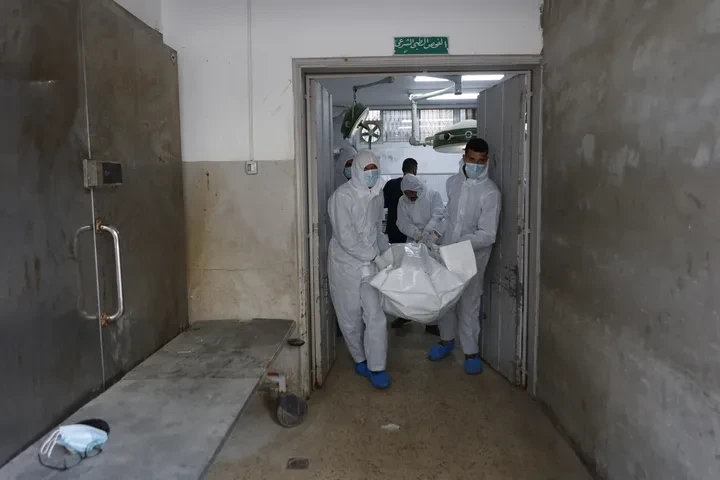
Not long ago in Gaza, registering a person’s death was a straightforward administrative process, much like it is in most regions across the globe. When a body was brought to a local hospital, medical staff completed all required paperwork in coordination with civil authorities. This routine step allowed families to update official records, settle inheritance claims, access bank accounts, apply for assistance, and secure legal guardianship for children who lost a parent.
All of that changed, however, amid heavy Israeli bombardment, the widespread detention of Palestinians, and repeated rounds of mass displacement across the enclave. Since October 2023, the systems for identifying remains, recording deaths, and resolving outstanding legal matters have been pushed to the brink of collapse. “This is an unfolding legal crisis,” said Ahmed Masoud, head of the legal department at the Palestinian Center for the Missing and Forcibly Disappeared. “Thousands of cases are now trapped in a legal limbo with no clear path forward.”
Many of these families suspect their relatives have been killed, but cannot prove their death in a form that law recognizes. Other families watched their loved ones be taken by Israeli forces, but have not been able to confirm they are detained, or learn where they are being held, leaving their fate completely unknown.
New research confirms this problem is widespread across Gaza. The Palestine Reporting Lab, WIRED’s reporting partner for this story, partnered with the Institute for Social and Economic Progress (ISEP), a Palestinian research organization, to measure the impact of Gaza’s missing persons crisis. Based on a survey of 600 people across 53 locations in Gaza, ISEP estimates that more than 51,000 people have been registered as missing at some point since October 2023, with roughly 14,000 to 15,000 still unaccounted for today.
Per ISEP’s data, more than two-fifths (42.9 percent) of households with a missing member report they have been unable to obtain an official death certificate. Roughly the same share say the missing person was their household’s primary breadwinner. Wives of missing men are often locked out of their husband’s bank accounts, and cannot access legal documents, pension payments, or other benefits held in his name.
The scale of harm captured in the data is staggering. Among Gazans reporting a missing household member, 71.4 percent said the disappearance has violated their family’s legal rights and blocked them from accessing entitled benefits. More than one in four (28.6 percent) reported struggles to establish guardianship of a child, while 14.3 percent faced barriers to getting married or finalizing a divorce. Financial ruin is a common outcome: one-third (33.3 percent) of households cannot access bank accounts linked to their missing relative, nearly one in five (19.1 percent) have been denied access to aid reserved for widows or children who lost a parent, and nearly one in 10 (9.5 percent) cannot claim an inheritance left by the missing person. (To generate its total missing person estimate, ISEP used quota sampling to survey a representative cross-section of Gazans across 53 locations in the strip, then cross-referenced results with existing pre- and post-war data on Gaza’s population and average household size.)
Samah Al-Shareif, a lawyer at the Gaza-based Women’s Affairs Center, which provides legal support to affected families, says the group has handled hundreds of cases where a parent cannot access aid for themselves or their children solely because of missing paperwork. She described one case of a woman whose husband retired before the war, and the couple relied entirely on his pension for income. When he disappeared, the woman discovered she could not access his bank account or continue receiving his pension. “The bank has refused to deal with her,” Al-Shareif said. “They insist she either produce a death certificate or bring her husband to the bank in person.” The woman has been left with no income or financial security, despite her husband’s legally entitled benefits.
Children with missing parents are perhaps even more vulnerable than adult family members. Nedal Jarada leads Al Amal Institute for Orphans, one of Gaza’s longest-running social welfare organizations. He says the group’s work has been severely hobbled by the lack of official documentation. Some children believe their parents were killed, but their relatives cannot prove it legally; others have no information at all about a parent’s fate. Jarada calls these children “de facto orphans,” a new category that has emerged in Gaza since October 2023.
Al Amal has supported hundreds of these cases. The group tries to find workarounds to help these children by asking adults in their lives to provide alternative evidence of a parent’s unknown fate: records of inquiries to official bodies, messages sent to human rights organizations, screenshots, or call logs that document attempts to locate the missing person. But such proof is not always available, and Jarada says his institution cannot assist many families, as the total number of orphans in Gaza already far outstrips their capacity. “These are the most painful cases,” Jarada said. “For many families, even receiving confirmation that your loved one is dead is easier than living with complete uncertainty.”
According to Al-Shareif, many wives of missing people face intense social pressure, community suspicion, and isolation. In some cases, the vulnerability created by disappearance exposes women to exploitation. The center has documented cases of missing men’s wives being targeted for sexual extortion by individuals who falsely claim they can help secure support or paperwork. “These abuses occur because women are perceived as unprotected—without a partner or social shield—and because they are navigating urgent needs such as financial assistance, documentation, or access to aid,” she said.
The ISEP survey captures the widespread mental toll of the crisis: 91.7 percent of people with a missing relative reported constant anxiety, while 68 percent said simply learning their loved one’s fate would fundamentally change their family’s major life decisions.
Faced with a growing legal crisis of missing people, Gazan authorities proposed a new policy in November 2023 to allow families to classify a person as deceased if they have been missing for more than six months, as a practical response to the mounting backlog of unresolved cases. But the policy was immediately ruled “illegal” by Palestinian Authority judicial officials based in Ramallah; under existing Palestinian law, the PA argued, a missing person can only be legally treated as deceased if unaccounted for for four years.
In January, the Palestinian Authority’s cabinet announced the formation of a national task force to address the growing file of missing persons. The task force, overseen by the Justice Ministry, has launched a digital form for families to log information about their missing loved ones. But it has not yet begun substantive work to resolve cases.
Amid Israel’s ongoing blockade of Gaza, and deep administrative fragmentation between authorities in Gaza and Ramallah, the question of how to proceed remains entirely unresolved. Some Gazan civil society groups are pushing for the creation of a comprehensive centralized database of the missing, to record and track cases of disappearance in a consistent, unified system, rather than scattering records across dozens of disconnected institutions and organizations. Human rights experts note such databases, which can hold evidence of disappearance and even collect family genetic samples for future identification, need to be managed with transparency and integrity to earn the trust of affected communities.
Other advocates call for the issuance of temporary, formalized recognition of missing status—documents often called “certificates of absence” in other contexts of war, atrocity, and disaster. These certificates strike a balance between upholding the rights of the missing (people who, by definition, may still reappear) and meeting the needs of families to access bank accounts, government and humanitarian aid, and move forward with civil and legal processes like marriage or guardianship.
Unlike formally declaring someone dead, these certificates keep open the possibility of future accountability, preserving the obligation under international law for governments to fully investigate all cases of disappearance.
“Without legal mechanisms to recognize disappearance as a distinct status—and without emergency protections for families—wives of the disappeared remain suspended between life and death, between responsibility and powerlessness,” Al-Shareif said.
This article was produced in partnership with the Palestine Reporting Lab, a project of Just Vision.
The Hidden Legal Crisis of Gaza’s Missing Thousands