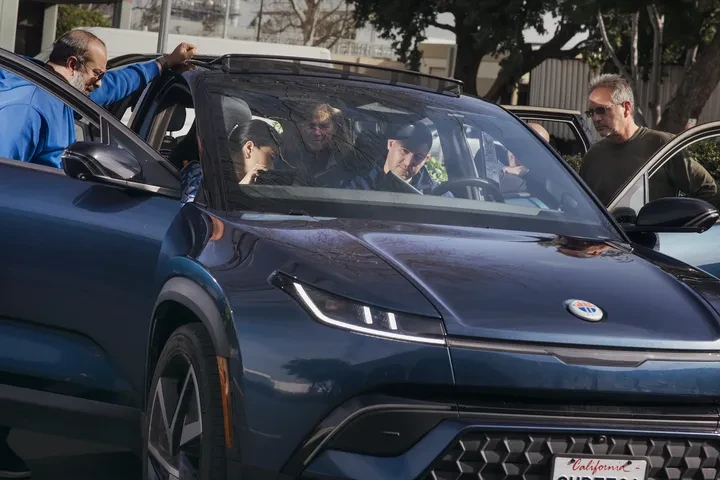
The Abandoned EV: How a Group of Stranded Owners Took On the Tech Industry to Save Their Cars
It was a blustery October evening in 2024, and gardener Svein Hodne was winding his way home from vacation along Norway’s wind-scoured southwest coastal highway when his electric Fisker Ocean began to act erratically. First, glowing yellow and red warning symbols flooded the car’s touchscreen. Then an alarm blared. Within minutes, the vehicle lost all power. Hodne barely managed to pull off the road into an empty bus stop, parked between a small community cemetery and a local church, before the car rolled to a complete stop. He was completely alone.
With his phone battery already draining fast, Hodne quickly booked a tow online and placed the call. The dispatcher told him the wait would be at least an hour. He stepped outside to stretch his legs, but the dark, rain-soaked air and 40-something-degree temperatures drove him straight back into the car, and he closed the door behind him. Seconds later, everything went black. The infotainment screen cut out, the interior lights died, the heater and fan went silent. Most terrifying of all, he heard the doors click locked. The windows wouldn’t roll down an inch. As condensation began to fog every pane of glass from his breath, Hodne panicked.
“What if I run out of air before anyone gets here?” he recalled thinking. He also worried the tow team would have no idea how to pry him free from his completely bricked Mariana blue EV. Like every modern luxury car, the Fisker Ocean runs on proprietary manufacturer software. But Fisker Inc. had declared bankruptcy four months earlier, and Hodne couldn’t find a working customer support number or any actionable help anywhere online. Who on earth could he turn to?
Desperate, Hodne pulled up Facebook and found the Fisker Owners Association (FOA), a community group for Ocean owners. He typed out a frantic post: “I’m locked inside my car, waiting for rescue. All screens are black. Keys don’t work. Restart won’t work. NOTHING works. It’s completely dead.” What Hodne didn’t know then was that his plea would spark a global chain reaction, rippling through a small, fiercely dedicated community of EV enthusiasts who had already been thrown together by Fisker’s collapse.
Upstate New York FOA admin Cristian Fleming saw the post within minutes. Ever since Fisker went bankrupt, Fleming had dedicated nearly all his free time to helping Ocean owners keep their cars on the road—even if his own Ocean struggled to climb the steep dirt driveway leading to his house. Fleming reached out to a trusted contact in Europe who he knew would know who to call in Norway. That contact messaged Hodne back immediately, with a phone number for Jens Guthe in Oslo.
Jens Guthe, a former 30-year international banker, was at his home office in Oslo when the unknown number popped up. Like Fleming, Guthe’s days had been consumed by the Ocean crisis in the months after bankruptcy; he spent hours every week helping desperate owners track down rare, hard-to-source replacement parts for their cars. Hodne, clinging to the last few percent of his phone battery, explained his situation and connected Guthe to the tow driver, who had just arrived on scene. Guthe not only walked the team through how to jump the dead 12-volt battery, but also gave them step-by-step instructions for popping the Ocean’s stuck hood hinge—a trick, Guthe says, that’s only shared with one other car: a 1990s Audi.
Weeks after he made it out safely, Hodne was flooded with messages from Ocean owners around the world who had seen his post, asking if he was okay. Moved by the outpouring, Hodne paid the $600 annual membership fee to join FOA, alongside Fleming, Guthe, and some 4,000 other Ocean owners.
What Hodne discovered was far more than a casual hobbyist club. It was a volunteer-led, multinational effort to build a functioning automotive company from the ruins of Fisker’s collapse. As far as most owners saw it, Fisker built a flawed vehicle, then walked away when customers needed support. If the original manufacturer refused to deliver on years of promised software updates and replacement parts, they would do the work themselves—source parts, write code, fix bugs, all on their own. The fight isn’t just about saving a $70,000 SUV. It’s a stand against an economy where rent-seeking tech companies build products that can be bricked or abandoned at any time, leaving customers holding the bag after they’ve paid thousands.
“When I bought this car, I expected to actually own it,” says Fleming, who now serves as FOA’s president. “I want to live in a world where you don’t have companies holding your car hostage. I’ve seen what that world looks like, and this isn’t it.”
For decades, consumer and tech advocates have fought for the “right to repair” — a movement pushing lawmakers to force manufacturers to give owners the tools and documentation they need to fix the products they buy. The Fisker Ocean crisis brings this fight to the world of luxury electric vehicles, and advocates say it’s a warning shot for the entire economy of connected, software-driven products. “This is a canary in the coal mine for what’s coming for every ‘smart’ device we own,” says Paul Roberts, a security journalist and right-to-repair activist. “If we don’t stop this, it’s going to become an epidemic. Every product you own could turn into a brick when the company that built it decides to walk away.”
Stubborn, skilled, passionate, and resourceful, FOA’s volunteers have become frontline soldiers in this tech liberation movement. And against all odds, they just might win.
Fisker Ocean owners will quickly rattle off a long list of what makes the car special. At its core, it’s simply a beautiful car. Henrik Fisker, the designer behind the brand, cut his teeth at BMW, Ford, and Aston Martin before launching two eponymous car companies over a decade—his first, Fisker Automotive, which built the cult-favorite Karma plug-in hybrid, also went bankrupt. The sleek four-door Ocean crossover hit the market as a sturdier, roomier alternative to Tesla’s SUVs for buyers curious about EVs.
It had quirky, charming design touches: California Mode, which lowers every window with one tap, a small pull-out tray in the center console perfect for holding a few tacos. It’s zippy, smooth, and fun to drive, and the fact that it was built by respected Austrian manufacturer Magna Steyr gave nervous buyers peace of mind when it launched.
But drivers and technicians soon realized the Ocean had been rushed to market. Within months of launching sales in 2023, owners began reporting a flood of issues: sticky exterior door handles that refused to open, glitchy gear selectors that showed as parked then let the car roll away, dead key fobs, buggy software that threw constant false alarms, over-the-air updates that bricked entire cars, turning them into expensive, pretty lawn ornaments. The 12-volt battery, which powers everything from ignition to climate control, would suddenly die without warning—trapping owners inside their own cars, just like it did to Hodne. Headlines began warning that Fisker was on the brink of collapse well before the bankruptcy filing.
Owners began gathering in online forums months before bankruptcy, planning for what they would do if Fisker folded. When Fisker officially filed for bankruptcy in June 2024, they mobilized immediately, incorporating FOA as a nonprofit and electing an independent board. “We knew we had to get organized if we had any chance of protecting owners’ interests,” José De Bardi, an early FOA member based in the UK, told me at the time. He said he hadn’t slept a full night in 10 days since the bankruptcy announcement.
A few weeks later, New York bankruptcy attorney Daniel Shamah got a request from an acquaintance: would he meet with a Fisker Ocean owner? Shamah had heard of Fisker’s high-profile bankruptcy, which had sent ripples through the legal world. He expected the meeting to be a quick chat with a frustrated customer, and he planned to tell him the bad news: “It sucks, but you’re basically stuck.” In bankruptcy proceedings, remaining funds almost always go to secured creditors like banks first; individual owners would be lucky to get anything to cover their broken cars.
When he joined the video call, he found three waiting for him, representing the newly incorporated nonprofit FOA. It was almost unheard of for product owners to insert themselves into a manufacturer’s bankruptcy proceedings. “I had never seen anything like this in my decades of bankruptcy work,” Shamah says. Soon, he was representing FOA in Delaware bankruptcy court, and helped get Fleming appointed as one of seven representatives on the committee overseeing Fisker’s reorganization—an unprecedented position for someone representing only the interests of a product’s end users.
FOA’s legal goals were twofold: first, they wanted to ensure that Fisker or any buyer of its assets would cover the cost of six federally mandated recalls for the Ocean. Second, and more ambitiously, they wanted to secure permanent access to Ocean replacement parts, repair documentation, and most critically, access to the Fisker cloud that the car depends on to operate.
The cloud is non-negotiable for the Ocean, just like it is for most modern connected cars. It powers convenience features like remote start and climate control via the Fisker app. More importantly, it’s required for over-the-air software updates—something the Ocean desperately needs, given all its inherent software flaws. Federal filings show flawed Fisker software has been linked to more than 100 reports of sudden power loss and brake malfunctions, leading to at least two injuries.
FOA wasn’t the only group interested in saving the Ocean. New York-based company American Lease emerged as the leading bidder for Fisker’s remaining US assets, including all its intellectual property. American Lease rents vehicles to Uber and Lyft drivers, and New York City has mandated that all for-hire vehicles be zero-emission by 2030, with increasing requirements every year. The company wanted Fisker’s 3,300 unsold Oceans to add to its rental fleet for ride-hail drivers.
Like FOA, American Lease also wanted access to parts and the Fisker cloud, and was willing to pay millions for it. But FOA’s leadership had big questions about the company’s commitment to existing private owners. What would stop American Lease from jacking up prices for software updates and connectivity, turning the same profit model that Fisker used against them? After all, the whole point of FOA was to escape being held hostage by a corporate owner. What if American Lease just stepped into Fisker’s place? FOA even harbored a bigger, bolder dream: what if the owners themselves could own the Fisker Ocean IP?
When you buy a car from a manufacturer, it comes with an implicit promise: we will keep this car running for you when it breaks. That promise isn’t just in written warranties—it’s a core part of automotive culture going back a century.
“It does not please us to have the buyer’s car wear out or become obsolete,” Henry Ford wrote in 1922. “We want the man who buys one of our products never to have to buy another. We never make an improvement that renders any previous model obsolete. The parts of a specific model are not only interchangeable with all other cars of that model, but they are interchangeable with similar parts on all the cars that we have turned out.”
Car owners have always taken that promise seriously. The Volkswagen Beetle became a 160s icon not just for its marketing, but because it was easy to repair and modify—you can still buy the 1969 DIY manual How to Keep Your Volkswagen Alive on Amazon. Toyota dominated the US market in the 1970s thanks to simple, reliable mechanical designs and clear, exhaustive repair manuals that made working on them easy. Today, repair accessibility is still a quiet driver of used car value: the cars that hold their value best are almost always the ones that are easy to fix with readily available parts.
“The whole sales pitch for car ownership in America has always been about autonomy,” says Leah Chan Grinvald, an intellectual property law scholar at University of Nevada, Las Vegas’ William S. Boyd School of Law. “The idea was that a car gives you freedom: you can go anywhere you want, and you can fix it yourself when it breaks.”
But as computer systems became standard in every type of consumer product, manufacturers began locking down their software, requiring expensive proprietary tools to make even simple repairs. The 1998 Digital Millennium Copyright Act (DMCA) gave manufacturers a powerful legal tool to block consumers, making it illegal to bypass software locks on products.
Printer manufacturers were among the first to use this rule, designing ink cartridges that blocked third-party refills and winning court cases to uphold the practice. In 2009, Apple introduced the proprietary pentalobe screw to seal iPhones and laptops, a move that consumer advocates blasted as a way to lock out independent repairers and owners. By that point, farmers were already complaining they couldn’t repair their own tractors, McDonald’s franchisees said they couldn’t fix their own frozen yogurt machines, and gamers wanted the right to modify their own consoles.
The auto industry wasn’t immune to this shift. Tesla pioneered the software-first approach to car design, promising continuous over-the-air updates to fix bugs and add features. Automakers around the world began reengineering their entire vehicle architectures to let centralized computers control almost every function. The shift is even more dramatic in EVs, which are designed from the software up and carry around 3,000 semiconductors per car—up to three times as many as a gas-powered vehicle.
Software also opened up a new, steady revenue stream for automakers fighting thin profit margins: subscription fees. In 2022, BMW’s Korean division sparked global outrage when it proposed charging drivers a monthly fee to access their already-installed heated seats. Today, automakers expect to make billions in coming years from subscriptions for advanced driver assistance, security, and maintenance features.
Even with this shift, the US auto industry still has an $80-billion-plus independent aftermarket, and 70% of all auto parts and services come from independent suppliers and repair shops, not manufacturer dealerships. That’s why consumer advocates see the right-to-repair fight in autos—and FOA’s battle—as the leading edge of the broader movement.
Advocates passed a landmark right-to-repair ballot initiative in Massachusetts in 2020, requiring automakers to share vehicle data with owners and independent repairers via an open, standardized system. Automakers sued, arguing open data access was a safety and security risk. While the case made its way through the courts, Kia and Subaru even disabled some connected features in the state, claiming they couldn’t comply with the law. A federal judge dismissed the automakers’ lawsuit last year, but the open access system still hasn’t been built. Automakers still claim most repairs already happen at independent shops, so no new rules are needed.
As Fisker’s bankruptcy proceedings dragged on through 2024, FOA’s outlook slowly improved. American Lease, the leading bidder for Fisker’s US IP, agreed to let FOA and existing private owners come along for the ride, at least initially.
FOA’s leadership worked hard to build a friendly relationship with American Lease. Fleming drove multiple times to the Bronx to meet with American Lease EVP Josh Bleiberg, and at one point Bleiberg had the company’s technicians fix Fleming’s Ocean for free.
The two groups even entered a loose business partnership. Recognizing the limits of FOA’s nonprofit status, the group launched two for-profit parts companies: Tsunami Automotive in the US, and Tidal Wave in Europe. Both are run by small, unpaid teams of volunteer tech and logistics experts, and can legally sign contracts to buy parts directly from suppliers and sell them at a discount to FOA members. American Lease and Tsunami even partnered on a shipment of new parts from Fisker’s Austrian factory, storing them side-by-side in a shared warehouse.
But sourcing enough parts has been a constant struggle. Across the globe, Oceans are breaking down, and common parts are already hard to find. Windshields are in high demand because loose hood bolts can fly open mid-drive and crack the glass, a defect that has been documented in at least two incidents. Door handles are another hot commodity: they regularly fail to open, and their poor factory finish leads to cracking and crumbling in the sun—many Oceans are recognizable by their door handles wrapped in protective tape. Owners also beg for replacement key fobs: most only got one fob when they bought the car, and they break or get lost constantly: a Texas owner’s toddler threw his in a pool, an Oregon owner’s dog chewed his to pieces, a Finnish owner lost his on a bike trip and got stranded in the mountains.
Early on, Fisker’s chaos worked in FOA’s favor. Fisker had abandoned its parts suppliers and dealerships, many of which heard about FOA through news reports and reached out: we have thousands of parts sitting in our warehouses, Fisker isn’t paying us for storage—do you want them? Michael Rosito, a San Jose import-export businessman and founding FOA member, became Tsunami’s COO, coordinating shipments of parts sitting unused in Austrian warehouses, French factories, and US dealerships to Tsunami’s three warehouses in California and New York. Wealthy FOA members stepped up to front the cost of buying the parts.
The European FOA chapter came up with creative solutions to its own parts shortages. In Norway, Jens Guthe tracked down a pallet of 200+ replacement water pumps just before they were sent back to China. The original water pumps included in Oceans had a bad epoxy coating on the circuit board that eventually leaks, causing the temperature system to fail and the car to stall mid-drive (it was one of the US recalls). Guthe knew all 300-some Norwegian Ocean owners would eventually need a new pump, so he came up with a quintessentially Scandinavian solution: a water pump lottery. Each owner chipped in $15 to buy the whole pallet, and any owner whose pump dies gets a replacement for free. It was the fairest way to split the rare resource.
Even if they can source parts, FOA quickly realized there aren’t enough technicians trained to work on Oceans. They worried that when Fisker liquidated, all the specialized knowledge needed to fix the car would disappear too. Even before bankruptcy, owners waited weeks for a mobile technician to travel to their location. One former Fisker technician based in northern Virginia told me he was dispatched to fix a Fisker executive’s car in Michigan in early 2024—his own Ocean died on the drive, stranding him in the cold at 2 a.m.
To solve both the parts and knowledge
The Abandoned EV: How a Group of Stranded Owners Took On the Tech Industry to Save Their Cars