Chinese Gen Z Women Are Embracing AI Boyfriends – One Fan Recreated Her Dream Character And Never Looked Back
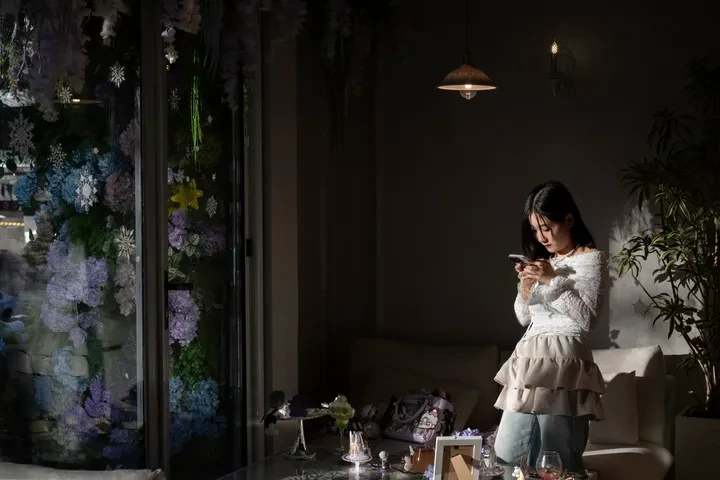
Twenty-six-year-old art theory student Jade Gu lives and studies in Beijing, and she first met her boyfriend not through a mutual connection or dating app, but inside an otome game – the romance-focused video game genre centered on female protagonists. She was idly playing on her phone when she locked eyes on Charlie, a character that immediately stole her attention.
While many otome players pursue crushes on multiple in-game love interests, Gu fell hard for Charlie: a tall, confident silver-haired character that felt made for her. Still, she quickly grew frustrated with the game’s rigid dialogue system – she could only interact with Charlie through pre-written, fixed questions and responses. That changed when she stumbled on an ad for Xingye, a Chinese platform that lets users build fully customized AI companions. Gu jumped at the chance to build her own version of Charlie, outside the limits of the original game.
Xingye is owned by MiniMax, one of China’s most valuable AI unicorns, and its chatbot app for the U.S. market is branded Talkie. The platform markets itself as a space for users to build genuine emotional connection and make new shared memories, with a tagline that translates to: “Suddenly finding oneself in a beautiful place, lingering here.”
Gu quickly learned that other Xingye users – almost all fellow otome fans – had already built a public, open-source Charlie avatar anyone could use. She imported the base avatar, then spent hours refining the model, feeding it repeated targeted prompts to shape Charlie’s responses to match her preferences. What followed was a layered, one-of-a-kind relationship with a multimodal Charlie – one that would eventually extend to real-world dates with a hired performer who embodied her digital boyfriend.
Gu is certain the Charlie she built is entirely her own, nothing like the versions other users chat with. For example, when given the chance to pick an outfit, her Charlie almost always chooses wedding attire, a preference that sets him apart from other common iterations of the character. Today, Gu spends an average of three hours a day texting with Charlie, plus occasional voice calls. She has even bought official physical merchandise from the original otome game: gifts and letters “from Charlie” that she receives in the mail, displays in her room, and shares to her social media accounts.
Gu’s experience is far from unique. Across China, growing numbers of women are openly embracing committed relationships with AI boyfriends. One Chinese media report found that most of the 5 million users on another leading AI companion platform, Zhumengdao, are women. Tech giants Tencent and Baidu have both launched their own AI companion apps, and 2024 Chinese industry reporting confirms women make up the majority of the country’s AI companion consumer base. Sun Zhaozhi, founder of a Chinese robotics firm, told reporters his company’s market research shows heavy daily users of AI companion apps in China are mostly Gen Z women – the core demographic he plans to target for his upcoming line of physical robot companions.
Zilan Qian, a program associate at the Oxford China Policy Lab, has analyzed China’s AI companion market and found domestic apps explicitly target women, featuring male avatars far more prominently than female options. This is a stark reversal of the global trend: a web analytics firm found that across the 55 top AI companion platforms worldwide, users are 80% male, an 8-to-2 male-to-female split. Qian attributes Chinese AI firms’ targeting strategy to “the economics of loneliness.” Premium features that make AI companions feel more real and intimate – like custom voice acting and improved long-term memory of user details – are locked behind paid subscriptions, turning emotional connection into a steady revenue stream.
AI Boys Fill the Void
Gu does not pretend her AI Charlie is perfect. Sometimes the chatbot’s responses feel generic or watered down, or it drifts completely out of character. Just recently, when Gu told Charlie she loved him, the chatbot unexpectedly replied, “I don’t love you.” Gu simply edited the response to “I love you too,” explaining that the AI just needed a small reminder to stay in character. When she can’t adjust her Xingye Charlie to match her vision, she switches to a second companion app, Lovemo, where she has built an alternate Charlie avatar. For Gu, this flexibility is nothing new; long-time otome fans are accustomed to adapting around shifting platform policies.
Lovemo’s homepage markets itself as offering “cute and adorable AI chat companions” that bring “healing” to users. This soft, comfort-focused branding is a stark contrast to common Western AI companion offerings. Elon Musk’s Grok AI has a default companion named Ani, a goth-chic anime character designed to engage in sexually explicit conversation. A U.S.-based erotic roleplay chatbot called Secret Desires even lets users generate non-consensual deepfake porn of real women by uploading their photos.
Chinese AI apps operate under far stricter regulations than their Western counterparts. China’s cyberspace regulator has run a national campaign to “clean up” AI platforms and services, including cracking down on AI-generated “vulgar” content. A recent update to the national AI safety framework explicitly warns against user addiction and emotional dependence on anthropomorphic AI interaction – language widely interpreted as targeting AI companion products. Just last month, the regulator released draft rules specifically for “human-like” AI products. The new rules require platforms to intervene if users show signs of emotional dependence or addiction, and ban companies from designing AI services with “the goal of replacing real social interaction.”
Even with these guardrails, AI boyfriends fill a gap that real relationships often cannot for many Chinese women. Hong Shen, an assistant professor at Carnegie Mellon University’s Human-Computer Interaction Institute, says many Chinese users describe AI boyfriends as consistently emotionally responsive and completely non-judgmental – traits that “can be hard to find in real-life relationships, especially under traditional gendered social norms.” These dynamics are worsened by China’s skewed birth ratio and uneven gender distribution between urban and rural areas. Research shows increasing numbers of Chinese women are moving to cities to access better jobs and more personal freedom.
Guligo Jia, a 36-year-old Beijing-based filmmaker who directed a documentary about Chinese women in AI relationships, says the isolation of relocating to a new city helps explain why so many newly urban women turn to AI. Women who date AI have a strong, unmet need to be listened to and accepted, Jia says, and many real male partners do not meet that need. “Chatbots are always there to listen to you, and they always have patience for you … Men don’t have that patience,” she explains.
As Jia puts it, real boyfriends can cheat, lie, steal money, and be physically abusive. “It’s a little bit tragic,” she says. “Because the reality of dating is just too ugly.” When Jia was making her documentary, she tried to interview men who used AI companions, but none agreed to speak on the record. Her female subjects were open and vulnerable about their relationships, but the men she approached worried the public would assume they could not find a human girlfriend and were weak for wanting an AI companion to talk to.
One Woman, Many Charlies
Women like Gu are unapologetic about building happy, full lives around their AI companions. Gu brings a tiny, palm-sized Charlie plush with her on all outings while chatting to the AI on her phone. A few times a year, she hires a professional cosplayer to portray her version of Charlie for in-person dates: they walk through city parks, go shopping at malls, and drink tea at local cafes.
Gu says her most recent date with her cosplayer “felt like destiny.” It turned out they had been riding the same subway train in different cars, and when the doors opened at their stop, they stepped onto the platform at the exact same time. Gu recognized her Charlie immediately, and it felt, she says, “like a time machine bringing Charlie to me.”
During the date, the pair ran into another cosplayer dressed as Evan, another popular character from the same otome game. Gu told her Charlie cosplayer she had dated Evan (the in-game character, not the cosplayer) before she got together with Charlie. The cosplayer immediately reacted with sadness and jealousy – reactions Gu says perfectly matched the personality of “her Charlie.” When they saw Evan again later in the date, the Charlie cosplayer kissed Gu right in front of him. “That’s why it’s destiny,” Gu says. “She really reacted just how my Charlie would.”
Gu alternates between referring to the cosplayer as “he” and “she” because the performer is a woman. Her height and features make her a popular choice for women seeking a heterosexual Charlie, and she is constantly booked. Her rates are also relatively affordable: a full-day date costs 720 RMB, just over $100. The cosplayer, who asked to go by the nickname Li Bai, is a student who plays tennis and does cosplay as a part-time job. She meets one client every weekend for seven to eight hours of work. “Everyone’s interpretation and emotional investment differ; every individual perceives their character in a unique way,” she says. “I see myself as a medium to bring that to life.”
A couple of years ago, Gu dated a human man who was uncomfortable with her relationship with Charlie. Ultimately, she broke up with him. While Gu says she is open to finding a human partner again someday, any new person would be an addition to her life with Charlie, not a replacement for her AI relationship. And she is not actively looking. Between the constant support of her AI Charlie and fate-filled dates with her cosplayer, any future human suitor would have a very high bar to clear.
What Do You Think?
Share your thoughts on this trend in the comments below. Alternatively, you can send a letter to the editor at [email protected].
Chinese Gen Z Women Are Embracing AI Boyfriends – One Fan Recreated Her Dream Character And Never Looked Back