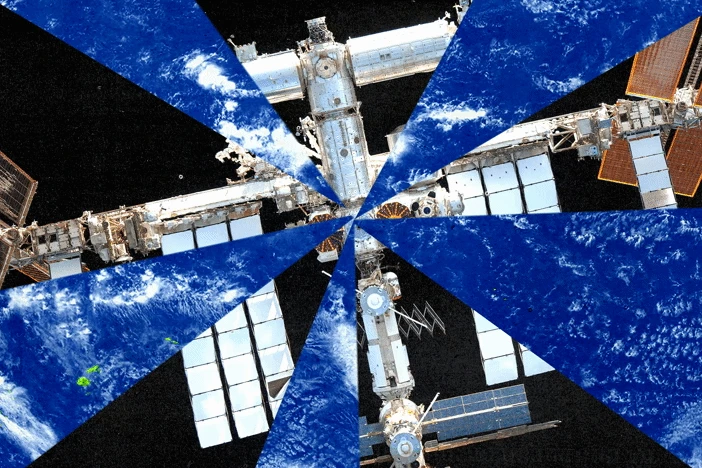
What If The ISS Suffers a Catastrophic Breach? The Worst-Case Scenario, Explained
Take one of the most devastating disasters that could strike the International Space Station: a catastrophic puncture wound from orbital debris.
Low-Earth orbit is littered with millions of pieces of human-made and natural junk: discarded rocket boosters, shattered satellite fragments, and micrometeoroids, all zipping around at speeds topping 17,000 miles per hour. These pieces constantly collide, creating an ever-growing cascade of new trash that multiplies exponentially. While the vast majority of this junk is tiny, and most drifts far outside the ISS’s operational altitude, the region around the station is far from completely clean.
Small debris pelts the ISS constantly, in fact, leaving visible dents and cracks across its outer hull. But if a large enough piece punches all the way through the station’s structure, cabin air will rush out into the vacuum of space, triggering immediate emergency alarms. Pressure readings confirm the impact for the crew, and the rate of pressure loss tells them how much time they have to respond. One NASA estimate frames the stakes clearly: a 0.6-centimeter wide hole leaves 14 hours to seal the leak. A 20-centimeter breach leaves less than 60 seconds.
To avoid these catastrophic strikes, agencies rely on the Space Surveillance Network, a global array of military-built sensors that tracks large orbital debris. NASA monitors an unofficial safety buffer around the ISS nicknamed the “pizza box” — essentially a no-go zone for tracked debris. When a piece of junk is projected to enter this zone with a collision risk of at least 1 in 100,000, mission controllers order an avoidance maneuver: firing the ISS’s thrusters to shift the station out of the debris’ path. This strategy has been used dozens of times since the first ISS module launched in 1998. But the system has critical gaps: it only tracks around 45,000 larger debris pieces, all sensors pick up background noise that can hide small threats, and risk thresholds can sometimes miss dangerous objects entirely. In 2025, for example, Chinese astronauts were briefly stranded on their space station after debris damaged their return craft.
The ISS does have built-in in defenses, of course: fabric buffers wrap key systems, and a layered impact bumper called the Whipple Shield blunts the force of incoming debris. But that shield is only designed to stop pieces smaller than 1 cubic centimeter, and debris trackers only pick up pieces 10 cubic centimeters or larger. That leaves a dangerous gap in protection between those two sizes.
Any catastrophic breach would be terrible bad luck, but the risk is not zero. Back in 2017, researchers from NASA and a Russian space contractor calculated the odds of this worst-case scenario at 1 in 121. As of late 2025, NASA told WIRED the risk of a debris-caused depressurization event in any given six-month period ranges between 1 in 36 and 1 in 170.
If the crew has enough time to respond, they will work to seal the leak or close the hatch isolating the damaged section of the station — a strategy that successfully managed a small, persistent leak in the ISS’s PrK module for years, with no major issues. But in the worst-case scenario, time is not on their side. Once cabin pressure drops to around 490 mm Hg, NASA notes, critical station systems begin to risk failure. Astronauts can develop hypoxia, severe oxygen deprivation that can quickly lead to delirium. If the leak cannot be contained, crew will have no choice but to board their return vehicles and abandon the ISS.
(A handful of other rare emergencies could also force evacuation: an electrical fire sparked by shorted machinery, or a toxic ammonia leak, for example, though both are even less likely than a catastrophic debris breach.)
If evacuation is completed, we are left with an empty, depressurized ISS, operating entirely via computer and remote control for the first time in decades. The first step for NASA and its international partners is to confirm that the station cannot be saved, and agree to a controlled deorbit. This process is not simple: the ISS partnership includes 23 European Space Agency member states, plus Japan, Canada, and Russia. Russia has only pledged to support the ISS through 2028, but has agreed to assist with contingency deorbit planning if needed.
There is no universal blueprint for abandoning the station, because every emergency scenario is different. But action is non-negotiable: an out-of-control giant space station drifting toward Earth is an unacceptable risk, even if it descends slowly under the oversight of the world’s leading space experts. In the best-case timeline, the U.S. Deorbit Vehicle, a modified Dragon capsule, will be ready to guide the ISS through atmospheric reentry, targeting an uninhabited safe zone in the Pacific Ocean.
But what if the Deorbit Vehicle is not ready in time? In that scenario, a 2024 agreement that uses Russian Progress cargo spacecraft to guide deorbit would be activated. This option comes with difficult trade-offs. Allowing the ISS to descend gradually on its own saves propellant that is needed for the final burn to steer it into the safe Pacific zone, but a slow descent puts the remote control systems at risk of damage. A controlled deorbit relies on core systems: communications, power, and avionics. Many ISS components were not explicitly certified to operate in a fully depressurized environment, though NASA technical analysis suggests critical systems would remain functional, and notes that many of these systems already operate in vacuum regularly. Another major risk is that the ISS could lose its orientation control, begin tumbling, and turn its solar arrays away from the sun, cutting off its primary power source.
Even if the deorbit proceeds with Russian hardware, there are drawbacks: NASA says this approach would result in a shallower reentry, spreading surviving debris over a larger area than planned. Even so, NASA would retain enough control to ensure almost all debris lands in the ocean, as intended. While the station would be deorbited earlier than planned, it is already an aging facility, and this outcome would still be largely safe.
But what if things go even further wrong? Even back in 1996, before the first ISS module launched, NASA planned for the worst possible outcome: uncontrolled reentry. This scenario requires an improbable, but not impossible, cascade of system failures. Depressurization could damage avionics, knocking out electrical power, thermal control, and data systems. Without those, coolant and propellant control systems can fail, leaving the ISS adrift. Over the course of a year or two, it would gradually drift closer to Earth, with no way to steer it or predict where its debris will land. Blowing the station up mid-orbit is not a solution: that would just create huge amounts of additional space debris, the very problem that created this crisis in the first place.
Earth’s atmosphere incinerates most falling space junk, no matter how the ISS comes down, but large chunks of the station can survive the heat of reentry. In a controlled scenario, air traffic controllers and maritime authorities can issue advance warnings, people on the ground can watch the streaking debris fall, and the remains of the historic engineering feat will land harmlessly in the ocean before sinking to the seafloor. In the fully uncontrolled worst case, there is no advance steering. While most chunks will still fall into the ocean, some could land in populated areas, spread across thousands of miles and multiple continents. Predicting exactly where debris will fall in this scenario is extremely difficult: as NASA puts it, “Calculating the probability of this penetration cascading into loss of deorbit capability has a very large range of variables, making predictions ineffective.”
This catastrophic scenario is extremely unlikely to happen to the ISS, but it mirrors a more extreme version of the only uncontrolled reentry of an American space station in history. In 1979, after years of being abandoned in orbit, Skylab — the U.S.’s first space station — began drifting into the atmosphere, threatening to drop molten debris on populated areas. NASA engineers only had limited control of the station, and had to remotely reactivate its computers to steer it toward the region that would endanger the fewest people. In the months leading up to reentry, NASA was in constant contact with the U.S. State Department, which shared the latest trajectory predictions with embassies across the globe.
Precedent shows how even planned deorbit can go wrong: when a Soviet Salyut space station was deorbited decades ago, local news reports from Argentina recorded flaming debris scattered across populated areas, frightening residents and prompting fire department deployments. The ISS is far larger than either Salyut or Skylab. In an uncontrolled reentry, experts on the official ISS advisory committee note that debris pieces “up to car and train size” would fall to Earth. NASA confirms this scenario would pose “a significant risk to the public worldwide.”
OK — the nightmare scenario is over. Here are the key facts as they stand in 2026:
As far as WIRED can verify, no one has ever been killed by falling space station debris. Pieces of Skylab fell on a remote region of Western Australia in 1979, and while Jimmy Carter issued a formal apology, no one was hurt. The odds of a piece of debris hitting a populated area are low: 70% of Earth is covered by ocean, and most land area is uninhabited. In 2024, a piece of trash ejected from the ISS survived atmospheric reentry, fell through the sky, and crashed through the roof of a Florida man’s home. He shared the story on social media and sued NASA, but he was not injured.
For this story, WIRED reviewed dozens of NASA documents, including backup plans and emergency contingencies, and spoke to more than a dozen people including three astronauts who have lived and worked on the ISS. No one we spoke to expressed significant anxiety about this risk. One astronaut told us the most worrisome scenario that crossed his mind regularly while in orbit was getting a toothache. The ISS has had minor emergencies over the years, including the first full medical evacuation in January 2026, but overall it has been remarkably stable. In fact, one of the most impressive things about the ISS is that no major catastrophic event has ever occurred in its decades of operation. No experiment has spun dangerously out of control, no large asteroid has ever impacted the station.
But there is still an uncomfortable, persistent truth: you don’t know what you don’t know. That has been an apt description of life on this experimental orbital outpost for decades. Eventually, though, we know another truth will take hold: all good things come to an end, and what goes up must come down.
Mostly, anyway. Theoretically, we could still save the ISS and move it into a higher, longer-lasting orbit. NASA has calculated that boosting the station more than 640 kilometers above Earth would keep it intact for 100 years — but that would require at least 18.9 metric tons of propellant, roughly the weight of 2,000 standard airline carry-on bags. A 1,000-year extension would require at least 36 metric tons. If that does not sound like much, consider that no existing spacecraft can currently transport that much propellant to the station. SpaceX’s in-development Starship megarocket could haul a significant portion of that load, but NASA estimates it would struggle to dock safely with the ISS.
Perhaps that is the biggest irony of all. Space is huge, and mostly empty — and yet there is no easy way to throw large things away when we are done with them.
Animation: Jacqui VanLiew; source images: Getty Images
What Say You?
Let us know what you think about this article in the comments below. Alternatively, you can submit a letter to the editor at [email protected].
What If The ISS Suffers a Catastrophic Breach? The Worst-Case Scenario, Explained