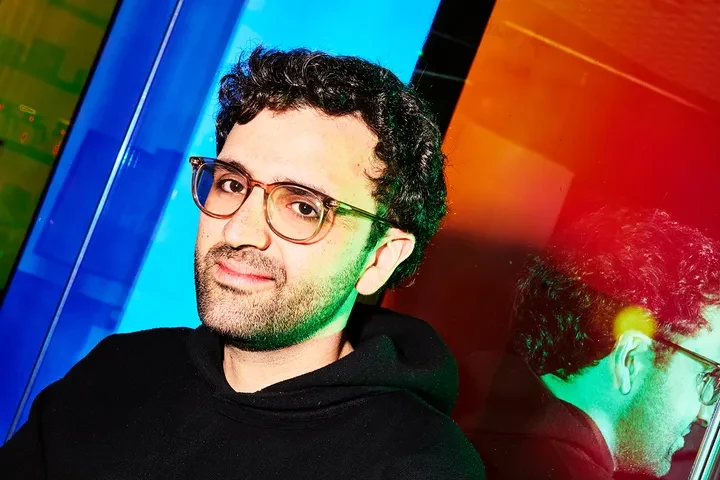
Everything Is A Market: An Interview With Kalshi CEO Tarek Mansour
If you correctly predicted a Seattle win for Super Bowl LX, you had no shortage of ways to turn that hunch into profit. You could place a standard wager on a consumer sports betting platform like FanDuel or DraftKings. Or you could stake the exact same sum by taking a position on Kalshi, a regulated prediction marketplace. Either way, you would have walked away with a payout.
But according to Kalshi cofounder and CEO Tarek Mansour, these two acts are fundamentally different. Kalshi is not a gambling site, Mansour insists—it is a full financial marketplace, overseen by the U.S. Commodity Futures Trading Commission (CFTC). As a startup, securing this federal regulatory approval is arguably its most impressive innovation. Kalshi is allowed to operate across all 50 U.S. states, 20 more jurisdictions than legal online sports betting, and it hosts markets for far more than just sports and election results (its most popular categories). Users can trade contracts on everything from tomorrow’s high temperature in Philadelphia to Taylor Swift’s wedding date, even whether Elon Musk will create a Bluesky account before 2027. Critics have long noted that many of these niche categories are vulnerable to manipulation by insiders with advance knowledge of outcomes.
This scrutiny has not slowed Kalshi’s explosive growth. The company’s trading volume has skyrocketed since it launched full election prediction markets in October 2024. Kalshi now hosts thousands of active markets, processes more than $1 billion in trades weekly, and most recently hit a valuation of $11 billion. (It is no coincidence that Kalshi means “everything” in Arabic.) Meanwhile, 19 U.S. states have filed suit against Kalshi, challenging its claim that its operations do not qualify as gambling and are not subject to state betting laws.
This rapid ascent is a full-circle moment for Mansour, a self-described math kid with mild OCD who was born in California, raised in Lebanon, and met his cofounder—Brazilian-born Luana Lopes Lara—at MIT. The pair took a huge risk by prioritizing regulatory approval before launching, and that bet has paid off better than any position traded on Kalshi itself. Mansour argues Kalshi is more than a profitable startup: it is a public good that surfaces more accurate collective information about future outcomes than any other forecasting tool.
You do not even need to risk money on one of Kalshi’s “event contracts” to see how quickly the platform’s collective wisdom narrows in on outcome probabilities. Kalshi’s markets outperformed traditional public opinion polls in predicting both Donald Trump’s reelection and Zohran Mamdani’s primary win in the New York City mayoral race. A recent study found Kalshi’s interest rate forecasts performed just as well as predictions from top Wall Street experts. That said, Mansour openly admits the platform missed big on one high-profile call: its prediction market for the next papacy gave future Pope Leo XIV almost no chance of being elected.
When I met Mansour at Kalshi’s Lower Manhattan headquarters, I found him sharp, charismatic, and unapologetically combative. Four years of navigating regulatory negotiations and fending off lawsuits have honed his skills as a debater who relishes defending his company’s social value. Pushback from critics who frame Kalshi as a platform that turns every corner of daily life into a betting parlor has only sharpened his arguments. Mansour jumped at the chance to convince me that a Kalshi position on the Super Bowl is nothing like a straight bet on FanDuel. He argues staking money on which song Bad Bunny will open his halftime show with is no different from buying Tesla stock or taking out a life insurance policy. Whether he persuaded me? That is an outcome Kalshi will have to price itself. Like everyone else, I cannot predict the future.
This interview has been edited for length and clarity.
Steven Levy: What drew you, a kid raised in Lebanon, to launch a prediction market startup?
Tarek Mansour: One of the most defining parts of growing up in Lebanon is just how much uncertainty there is everywhere. Math was the only place you could always count on certainty. My big obsession growing up was getting into MIT, and once I got there, my whole world expanded. Everyone was incredibly sharp and driven. A lot of my peers went into finance, which is a natural fit for people who love math, so I took a job at Goldman Sachs in 2016. That was my first exposure to the idea of prediction markets. That summer, almost all the demand centered on one question: will Brexit happen? Then after that, it was will Trump win the election? When Brexit passed, it was a massive shock that completely destabilized global markets. Trump’s win was even more striking. That got me thinking: what if people could price the probability of these simple questions about the future? Markets are the most efficient way to average out diverse opinions about an outcome.
Levy: I’m old enough to remember when comparing Wall Street to a betting parlor was a radical revelation. There was a famous 1985 BusinessWeek article called “The Casino Society” that criticized markets for decoupling from actual business results. Now it is widely accepted that stock valuations have far less to do with real profits and losses than they do with speculation on future price movements. Kalshi feels like the purest version of that—rooted entirely in speculation, with no traditional concept of investing at all. Why price the outcome of Brexit if you do not have a stake in related financial assets? If Brexit impacts stocks, why not just go long or short on the actual stocks that will be affected?
Mansour: I completely reject that premise. People who had to immigrate to or from the UK because of Brexit would have gotten huge value from an accurate forecast long before the vote. Most of those people did not have any position in the broader stock market. The idea that global events only matter if they impact stock prices is bizarre to me.
Levy: But you are the one who argues markets give us clearer, more accurate information.
Mansour: It is actually the only way to get real clarity, and we have proven it over and over. Yes, you can research a company and forecast where Apple’s stock will go. But you can also research commodity prices, tomorrow’s weather, whether COVID will come back, how a sports team will perform, any outcome you can name. All financial markets that have ever existed include speculation. Some people participate because they do not do deep research, but they find it interesting, they find it fun, or they have extra money they want to put to work. That is true of every market.
Levy: But you have extended this logic far beyond financial outcomes, to literally everything: from what words Donald Trump will say in his State of the Union to which band will open the Las Vegas Sphere.
Mansour: People were just as critical of option markets when they first launched, too. When the CME launched water futures in 2020—it is a fantastic product that helps communities prepare for water scarcity—the first headline was “Now you can bet on water.” That is when I realized we will always face this criticism. Yes, you risk money to make money on an outcome you do not control. That fits the dictionary definition of a bet. You could use the word “bet” to describe what people do in the stock market, too.
Levy: That is fair.
Mansour: When life insurance was first introduced, the initial public reaction was “you are betting on people dying.” Today we all agree life insurance is a net good for society. Any type of trading activity that involves speculation will share some characteristics with gambling, but that does not make it gambling.
Levy: But we regulate gambling differently from other financial activity. You insist Kalshi is not gambling—so what is the actual line between speculation and gambling?
Mansour: Gambling is tied to events that are artificially created purely for entertainment, like rolling dice.
Levy: We are not talking about dice rolls here. We are talking about speculating on who wins the Super Bowl. That is generally considered gambling.
Mansour: The Super Bowl is an event that exists whether or not people trade contracts on its outcome.
Levy: Whether you use FanDuel or Kalshi, if you risk $1, you get more money if Seattle wins and you lose your $1 if they lose. I do not see the difference from the user’s perspective.
Mansour: There is a fundamental difference in how the systems work. With traditional gambling, the platform is the house. The house’s revenue comes directly from its customers’ losses. That is why casinos built all sorts of mechanisms to make sure you lose more than you win over time. But in a true financial marketplace, there is no house taking sides. Kalshi only charges a small fee to facilitate trades, and the outcome of any event has no impact on our revenue. That is a core difference.
Levy: Even with that mechanism difference, a user is still making a bet. Maybe you just offer better odds than a traditional sportsbook. To the customer, it is still a bet at the end of the day.
Mansour: Better prices and better odds are a good thing for society. But there is a more fundamental difference. When you use a traditional sportsbook, the odds are inherently stacked against you. Our user base is much more analytical. It is like Moneyball—they rely on data and quantitative analysis. They love deep dives into the economy, and they like that on Kalshi, you just have to be smarter than other traders, not smarter than a rigged system stacked against you. A lot of people feel even the stock market is rigged against individual investors these days. How is an average person supposed to outtrade huge hedge funds on the stock market? The truth is, most of the time they cannot. On Kalshi, we have a level playing field. If you have studied inflation, or COVID trends, or pop culture, or Taylor Swift, or sports, you can have a real edge.
Levy: Gamblers have always believed research gives them an edge too—whether that is studying horse form or sports statistics. If you know more, you are more likely to win, that is true of any betting on events.
Mansour: Traditional gambling is structured to work against the end consumer, while financial markets are open and transparent. You can enter and exit a position whenever you want on Kalshi. If you start winning consistently at a traditional casino or sportsbook, they will shut your account down. That never happens here.
Levy: Even so, Kalshi users are risking real money, which can lead to serious financial harm. Gambling sites are required to post prominent responsible gambling disclaimers and links to support groups like Gamblers Anonymous. You do not have to do that because of your regulatory status. Why should you not have to?
Mansour: The CFTC has an extremely comprehensive customer protection framework that has been in place for decades. We operate under that framework, and CFTC-regulated markets have far fewer consumer protection issues than sports betting, even though they are inherently riskier. It is easy to criticize Kalshi because we are growing so fast, but we founded the company in 2018 and did not launch for four years, specifically because we wanted to get properly regulated upfront. We did not spend those four years sitting around doing nothing.
Levy: What were you doing those four years?
Mansour: It is comparable to getting a bank charter. There is a whole suite of requirements you have to meet around market integrity, consumer protection, how customer funds are stored, audits, reporting transparency, and compliance with federal rules. You have to prove your entire operation is structured to be safe, legitimate, and regulated from the ground up.
Levy: Some people would say you hacked the regulatory system to get this designation.
Mansour: Hacked? That makes it sound like we did something wrong! Should we be punished now for following the rules and getting regulated?
Levy: I do not mean it negatively—I have written about “good hackers” who work within systems to drive innovation.
Mansour: When we were 22-year-old cofounders just starting out, we decided we wanted to do this the right way. We wanted to bring this innovation to the U.S., we believed in prediction markets so much that we were willing to spend four years, however long it took, to get it right. We wanted to build something safe and responsible for the long term. Most coverage of Kalshi misses that, because none of our competitors did any of this work.
Levy: You are talking about Polymarket, your biggest competitor right now?
Mansour: There are a number of others. They were scaling up and grabbing market share while we were sticking to our principles and waiting for regulatory approval. We could have taken that same shortcut, but we wanted to do this right. Anyone can read the Commodities Exchange Act, and a 5-0 bipartisan vote of CFTC commissioners agreed with our reading of the law. When they disagreed with us on allowing election outcome contracts, we sued them and we won. The real validation is that millions of people trust the company now.
Levy: Donald Trump Jr. is a paid advisor to Kalshi. Why would you hire him, when he is not only an advisor to your main competitor Polymarket, he is also an investor in that company?
Mansour: Yes, he is an investor in Polymarket, and that just proves he is a strong supporter of the prediction market industry as a whole. He believes in what we are building, which is a great thing. He was completely upfront from day one that he has zero involvement in any regulatory or government-related work for Kalshi. That is clear to everyone.
Levy: What about markets where the outcome is already decided, but only a small group of people know it? For example, you have a market for who wins the 50th season of Survivor, which was filmed months before it airs. Can you actually detect if someone leaks the result to a family member who then places a big bet on Kalshi?
Mansour: If traders thought the system was rigged against them, they would stop trading. They have not stopped trading—we are processing a billion dollars a week, so clearly they trust the system is fair and safe. We follow the exact same insider trading rules as the stock market, with even more tailored protections for our specific types of markets. If you commit insider trading on Kalshi, it is a federal crime. Same as it is on the NYSE.
Levy: Early prediction markets, like the 1990s Iowa Electronic Markets or the early 2000s DARPA experiment to forecast terrorist attacks, were innovative non-profit projects designed to help see around the corner, not to build a multi-billion dollar business. Do you think scaling this into a massive for-profit company introduces new risks of manipulation, where the priority becomes profit rather than unearthing accurate information?
Mansour: If you believe prediction markets work, you should believe they should be more mainstream and as big as possible. The Iowa Electronic Market and other early projects were incredible, but now that we are a commercial business, millions more people use prediction markets than ever before—orders of magnitude more. That is a good thing.
Levy: That is exactly what worries critics. They say Kalshi promotes a worldview where every single event, even a sunrise or sunset, is an opportunity to place a bet. Why do we need to put money on everything?
Mansour: If people want to use Kalshi, we give them a safe, responsible way to do that. If they do not want to use it, that is totally fine. Who are we to tell people what they can or can not do with their own money?
Levy: You have made it clear you want to get many more people on Kalshi, and make it a central part of everyday life.
Mansour: That is what we work hard toward. Innovation does not happen by pulling back. Progress happens by expanding what is available and making it accessible to more people. We live in a free, open society. I do not buy the idea that we are forcing this on anyone.
Levy: You know a lot of people think this whole model is toxic, right? You did a Reddit AMA a year ago where people were extremely critical, one even asked you what it was like meeting the devil when you sold your soul.
Mansour: There should always be some dissent, and people are free to have their opinions. Some are grounded in facts, some are not, but that is just how it goes. Critics make it sound like I am going around the country luring people into this, like I am handing out candy to kids. Adults make their own decisions. If someone finds Kalshi useful and enjoyable, that is awesome.
Levy: You could say the same thing about cigarettes—adults are free to choose them, right?
Mansour: I do not see what this has to do with cigarettes. If people choose to smoke, companies are required to disclose the risks. I do not smoke, I barely drink. I trade, but that is completely different. I actually cannot even trade on Kalshi myself, which is maybe the worst part of building the company.
Levy: Do you make mental virtual trades when you look at the markets?
Mansour: I try not to, but I check the markets all the time, so I am an active user when it comes to following the forecasts. On social media, the whole incentive structure rewards clickbait. But if you talk to our most active users, their way of thinking about the world is honestly really impressive. They have an intellectually stimulating activity that makes them more calibrated and objective about their views. Conversations on Kalshi are more like math—they make issues less subjective and more objective. It depolarizes public conversation and helps us get closer to the truth.
Levy: Interesting. In an era where truth is constantly under attack, you frame Kalshi as a force that brings more truth to the world.
Mansour: Exactly. The core belief here is that markets do not lie the way people do. When people put their own money on the line, they stop lying about what they actually believe will happen. It is incredible to see that work over and over again.
What Say You?
Let us know what you think about this article in the comments below. Alternatively, you can submit a letter to the editor at [email protected].
Everything Is A Market: An Interview With Kalshi CEO Tarek Mansour