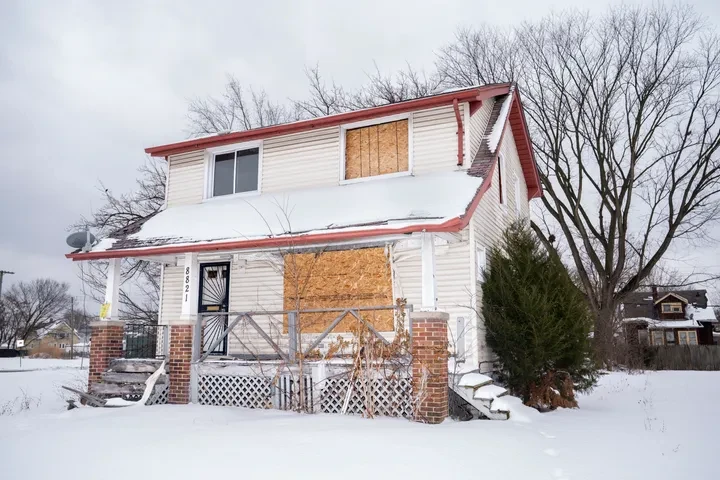
The Crypto Landlord That Bought Hundreds of Detroit Homes — And Left Tenants Trapped in Squalor
The scent hit me before I could even make out the space: cold damp brick, still stagnant water, fuzzy mold, and the sharp bite of bleach. I was halfway down a creaky wooden staircase leading to the basement of a 1920s duplex in east Detroit, Michigan. Leading the way was Cornell Dorris, who’d called this building home for nearly a decade. Now in his early 40s, Dorris has two daughters who visit every weekend, and he earns his living smoking barbecue and catering private events.
As my eyes adjusted to the dim light, I spotted rodent droppings scattered across concrete and a spreading black puddle pooled across the basement floor. “Any time it rains, this whole place floods,” Dorris told me. The air hung thick and heavy, and I couldn’t shake a persistent, itchy urge to get back upstairs and outside.
Dorris doesn’t have a run-of-the-mill landlord. Almost four years ago, his building was bought by a cryptocurrency startup called RealToken, more commonly known as RealT. The company built its brand on a promise to “democratize real estate investment” using blockchain technology. Their model was simple: split a single property into thousands of crypto tokens, each sold for roughly $50. Token holders would earn a cut of the property’s monthly rent, with projected annual returns as high as 12%. They’d also profit if the property’s value rose over time.
Investors jumped at the idea, and RealT poured its capital into Detroit, snapping up close to 500 residential buildings across the city. It also acquired roughly 200 more properties in more than 40 other cities across North and South America, pushing the total value of its portfolio to around $150 million. Due to US regulatory rules, American residents can’t buy RealT tokens, but at least 16,000 people from 150 other countries have invested. While independent verified numbers are hard to come by, RealT has previously billed itself as “the world’s largest real estate tokenization platform, by every measure.”
For all the fanfare RealT earned in the crypto world, it has been plagued by serious, on-the-ground problems in Detroit. Last summer, the city of Detroit filed a lawsuit against RealT and its co-founders, citing hundreds of blight code violations across its portfolio. Dorris’s building was among those city inspectors labeled unfit for human habitation. He told me that while his previous landlord was far from perfect, occasionally leaving him to coordinate small repairs himself, the building has decayed rapidly since RealT took ownership. Inspectors documented missing smoke detectors and no hot water running to the bathtub. “The only way I can bathe is standing over my kitchen sink,” Dorris said. “We’ve got rats downstairs, and squirrels getting into the walls upstairs.”
Tokenized real estate remains a tiny blip in the $55 trillion US housing market, as estimated by Zillow. But the broader idea of using crypto to sell fractional shares of everything from fine art and gold to oil and stocks has grown into a $30 billion global industry in just a few years, per Deutsche Bank. Yet in Detroit, the promise of letting anyone, even on the other side of the world, invest $50 to become a landlord has run headlong into the messy, physical reality of aging housing stock and the people who live in it.
The Libertarian Brothers Behind RealT
RealT was founded by two Canadian brothers, Rémy and Jean-Marc Jacobson. They aren’t identical twins, but they could pass for them: both wear glasses, have slicked-back hair, and sport matching salt-and-pepper mustaches. Both identify as staunch libertarians, who advocate for unregulated free markets and limited government power. When I met with Jean-Marc over Zoom, he spoke with intense passion and was quick to bristle. When I rambled trying to frame a question politely, he cut in: “Just ask it.”
The brothers grew up splitting time between Canada and Europe, part of a well-traveled family with a decades-long trail of cross-border legal battles. One sister’s acrimonious divorce ended in a high-stakes fight over a multimillion-dollar fortune stashed in the Bahamas, which she ultimately won. Their brother-in-law received a suspended prison sentence after being tied to a ring that illegally trafficked arms to Angola. When their father, a financier, was asked about the family’s wealth in a 2003 news article, he told the reporter: “Don’t ask and I won’t not tell you.”
Rémy and Jean-Marc have said they built their early real estate careers flipping properties across Quebec and parts of the United States. Then, in the early 2010s, they discovered bitcoin. Almost immediately, they launched their own bitcoin mining operation, followed by a string of other ventures and a nonprofit organization. The brothers also ran into trouble early in their crypto work: they lost money to a Ponzi scheme, and later settled a lawsuit from a client who accused their firm of withholding a crypto payment that is now worth millions of dollars.
As early as 2013, Jean-Marc says, the brothers began exploring how to combine their real estate experience with crypto. Traditional finance already offered real estate investment trusts (REITs), which let investors earn a cut of rental income from a portfolio of properties. But REITs typically require a minimum investment of thousands of dollars. The brothers searched for a way to use crypto to build a similar product that would work for much smaller individual investments. They didn’t crack the model until five years later, when Rémy got a fateful phone call from his lawyer.
Legally, you can’t directly sell one single home to a thousand separate people. But the brothers realized that if they transferred a property’s title to a dedicated limited liability company (LLC), they could create and sell crypto tokens that each represented a share of that LLC. That legal workaround made their model possible.
They began searching for a city to test their tokenization concept. Detroit, famous for its low-cost housing stock and post-bankruptcy urban renewal ambitions, was an obvious fit. “Detroit had just come out of bankruptcy. It was already on its way back up,” Jean-Marc said. “It was a natural choice for potential value growth. And mostly, for beautifying and improving neighborhoods.”
They bought their first Detroit property: 9943 Marlowe Street, a modest single-family home in West Detroit. In April 2019, they tokenized it, creating 1,000 tokens priced with a markup to cover fees, planned repairs, and a 10% cut for the Jacobson brothers. They also structured the deal to take a 2% cut of all future rental income. The rest of the monthly rent would go toward maintenance, property taxes, and other fees, with any remaining profit distributed evenly to token holders.
On the first day the tokens went on sale, Jean-Marc tells me, RealT sold fewer than five. The brothers begged friends and family to buy in, and promoted the offering on X, Medium, and in press interviews. “People were suspicious at first,” Jean-Marc said. “We sold very, very, very little.” After roughly five months, the brothers seriously considered selling the house, refunding everyone who’d bought tokens, and abandoning the whole project.
Slowly, however, the tokens for 9943 Marlowe began to move. By December 13 that same year, they had sold out completely. At that point, the property was owned by 107 investors from 33 countries, who each held an average 0.93% stake and split a combined $25.22 in daily rental income.
The brothers launched a Telegram chat group for French-speaking investors, and demand for RealT’s tokens began to skyrocket. In 2020, RealT went on a buying spree across Detroit: they tokenized an apartment building on Appoline Street, a four-unit building on Schaefer Highway, then a single-family home on Mansfield Street. That year alone, the brothers tokenized nearly 50 Detroit properties.
As they looked to expand further in Detroit, the brothers partnered with local real estate professional Shawn Reed. Court documents show Reed began sourcing properties, and sometimes oversaw renovations, for RealT to tokenize. What the Jacobsons didn’t know at the time was that Reed had a long criminal record: he had previously served prison time for conspiracy to commit bank fraud, and once even agreed he could be described as a “slumlord.” Even so, he helped the brothers close enough deals to keep up with the rapidly growing demand for RealT tokens.
"We're Regular People Who Want a Piece of Real Estate"
I spoke with one investor, who goes by the username TokNist on RealT’s Telegram groups, who said he understood the appeal immediately. A French citizen living in Asia, TokNist asked to remain anonymous out of fear of retaliation from other RealT investors. He had long wanted to buy real estate but couldn’t qualify for a mortgage. RealT offered him a way to invest small sums with no involvement from banks at all. “A lot of people are like me,” he said. “We aren’t wealthy speculators. We’re regular people who want a piece of real estate, and we want reliable fixed income.”
In 2022, TokNist began buying up RealT tokens. The process wasn’t always smooth. Whenever RealT was set to list a new property, he would wait at his computer, watching the countdown timer tick down. The website often crashed, leaving him with a blank screen, or tokens would disappear from his cart before he could check out. “The houses sold out instantly. You could have six or seven for sale the same day, and after a few minutes, every token was gone,” he told me. “It shows you, there is really a demand.”
Behind the scenes, as their portfolio ballooned, the Jacobsons began struggling to manage hundreds of scattered properties across multiple cities. In 2023, a bank foreclosed on a commercial property the brothers owned through a separate business venture in Miami, Florida, after they defaulted on a loan and were ordered to pay $10.4 million. The city of Miami had also labeled the property unsafe. (The Jacobsons call this episode a strategic decision made in response to the Covid-19 pandemic, and an outlier in their Florida track record.) That same year, the city of Chicago issued multiple fines against RealT-owned LLCs for alleged blight violations, code violations, and delinquent debt. It was an early red flag for the trouble that would soon explode in Detroit.
In the summer of 2024, Aaron Mondry, a reporter at the Detroit-based nonprofit news outlet Outlier Media, was working on his series The Speculators of Detroit about the city’s volatile housing market, when a source pointed him to a strange pattern in Wayne County’s property deed records. Scanning the registry, Mondry saw that hundreds of Detroit properties were owned by dozens of separate LLCs, all with names linked to RealToken. By that point, through these dozens of subsidiary LLCs, RealT had bought and tokenized hundreds of properties across Detroit, making it one of the city’s largest residential landlords. Most were single-family homes that RealT bought in bulk deals with other landlords, sometimes without ever sending anyone to view the units in person. RealT’s properties are heavily concentrated in low-income, majority-Black neighborhoods on Detroit’s east and west sides.
Mondry compiled a list of RealT-owned properties and began knocking on doors. He quickly noticed an alarming pattern: most of the homes he visited were in severe disrepair, a large number were sitting vacant, and public records showed property taxes had gone unpaid for many of them. In February 2025, Mondry published the first of several investigative stories on RealT, drawing on public records and interviews with tenants. The stories documented widespread mismanagement, cost-cutting, and neglect, with multiple tenants reporting they were living in unsafe, unsanitary conditions. Around the same time, city building inspectors warned RealT that an apartment complex on Cadieux Road had non-working smoke detectors, emergency lighting, and fire doors. In March, a fire ripped through the building.
Tenants Trapped in Unsafe Homes
I heard similar stories when I visited Detroit neighborhoods door-to-door in early September 2025. I drove my rental car past basketball hoops anchored down with cinderblocks, caught the smell of barbecue and the sound of music drifting over fences—small, bright pieces of daily life that stood in sharp contrast to the terrible condition of the RealT properties scattered across these neighborhoods.
When I pulled up to the Cadieux Road apartment complex, I found its fire-scorched remains boarded up with plywood. In the Grand River-St. Marys neighborhood in northwest Detroit, a self-described gang claimed it had seized control of 14881 Greenfield, a two-story brick apartment building with a distinctive red awning. In a YouTube video, the group says it is now acting as the landlord, renting out the run-down units. “For a drug addict, this is like five stars,” one person in the video says. Two other RealT-owned homes I visited were riddled with bullet holes. Multiple tenants told me they have stopped paying rent, in an effort to force RealT to make badly needed repairs.
At a Tim Hortons in Redford, on Detroit’s west side, I met Maya, a RealT tenant who lives in a boxy redbrick home nearby. Maya, who asked to be identified only by her first name, told me that when she gets home from work, she parks her car in the driveway and sits there, sometimes for as long as an hour, before she goes inside. In one bedroom, a persistent leak has rotted a large hole in the ceiling, exposing the home’s wooden roof supports. Paint peels off the walls, and clumps of waterlogged brown insulation hang down into the room. Maya only uses the bathroom, kitchen, and living room, and she sleeps on the living room couch. “I probably shouldn’t be living in it, to be honest with you, but I’m trying to find somewhere I can go,” she said. “It’s a slumlord city.”
A few blocks from Maya’s home, I knocked on the door of Monica, who has lived in a house south of the famous Eight Mile Road for six years, and recently started raising her two grandchildren there. The home’s tokens are owned by 331 separate investors, who have earned an average annual return of 9.3% on their investment, paid for by Monica’s monthly rent. Monica told me her heating is broken and her water supply cuts out unexpectedly. I could see for myself that several windows are shattered and the roof is damaged. A large dead tree looms over her front yard. At night, Monica can’t sleep, afraid someone will break in through one of the broken windows. She says she has repeatedly applied to move into an emergency shelter, but they are always full. “Go home, honey. Go home,” she told me. “It’s terrible here.”
On the fifth floor of Detroit’s Coleman A. Young Municipal Center, in a maze of cream-colored tile and worn carpet, I met Conrad Mallett, who oversees all of the city’s civil litigation. His office walls are lined with portraits of Muhammad Ali and leading figures of the Black Civil Rights movement. A former deputy mayor of Detroit and former chief justice of the Michigan Supreme Court, Mallett learned of Outlier Media’s reporting on RealT last spring. He launched a city investigation, and building inspectors fanned out across the city to assess RealT’s properties and catalog code violations. “It turns out, there were thousands,” Mallett told me. “We concluded, in the vast majority of cases, people were living in substandard housing.”
Mallett’s deputy, Tamara York Cook, sent inspectors door-to-door and had them leave her business card taped to the front door of every non-compliant property. Soon, her phone started ringing nonstop. “Most people are fairly anxious to tell their story,” she said.
In July, the city of Detroit filed a civil lawsuit against RealT, its co-founders, and 165 associated LLCs. The lawsuit accuses the company of hundreds of public nuisance and regulatory violations, and failing to pay hundreds of thousands of dollars in blight fines and unpaid property taxes. It alleges that 408 properties lack the city-required “certificate of compliance” that proves a home is safe for habitation. (The Jacobsons told WIRED that “RealT’s tokenized portfolio was no better or worse than any other property in the zip codes concerned when it came to CoCs.”)
Shortly after the lawsuit was filed, a judge issued a temporary restraining order barring RealT from collecting rent or evicting tenants at any of the Detroit properties named in the lawsuit until the homes are brought up to code. The order was later extended, but modified to allow RealT to evict tenants who do not pay rent.
On RealT’s Telegram investor groups, a few investors caught wind of the lawsuit, and Rémy Jacobson jumped in to reassure them. Most RealT investors have almost no independent insight into what is happening in Detroit beyond what the Jacobsons tell them. “We are committed to addressing every issue,” Rémy wrote. Twenty-one investors responded with a heart emoji. Jean-Marc added his own comment, highlighting the strong growth of Detroit’s real estate market to calm investors.
Around that same time, the Jacobsons told investors that a potential buyer had expressed interest in the building where Cornell Dorris lives—the one with the perpetually flooded basement. If investors approved the sale, they would earn a massive 75.61% gross return on their investment. In Telegram posts, Jean-Marc framed the sale as proof of the Detroit real estate market’s strength and RealT’s skill at dealmaking. During a late July call with investors, Jean-Marc announced the property sale was “done.”
But the buyer, East Coast Servicing LLC, is registered to the exact same Michigan address that RealT uses for its own corporate filings. The purchase documents are signed on behalf of the buyer by Rémy Jacobson. The deal appeared to be a transaction between two companies controlled by the Jacobsons themselves. After I followed up with the Jacobsons about the deal in February 2026, they sent an email to investors saying the buyer had pulled out of the deal, despite having announced in July that the sale had already closed. The brothers later told WIRED that East Coast Servicing LLC is just a shell company they use to help administer property sales to foreign buyers.
Blame Game and Growing Scandal
The city of Detroit’s core argument in its lawsuit is that property neglect is baked into RealT’s business model. “The way they’re able to generate the [high annual return] is by not maintaining the houses in a quality manner,” Mallett alleges.
Jean-Marc Jacobson rejects that claim entirely. He says the brothers’ goal from the start was to help improve Detroit neighborhoods by opening up investment to a wider range of people
The Crypto Landlord That Bought Hundreds of Detroit Homes — And Left Tenants Trapped in Squalor